

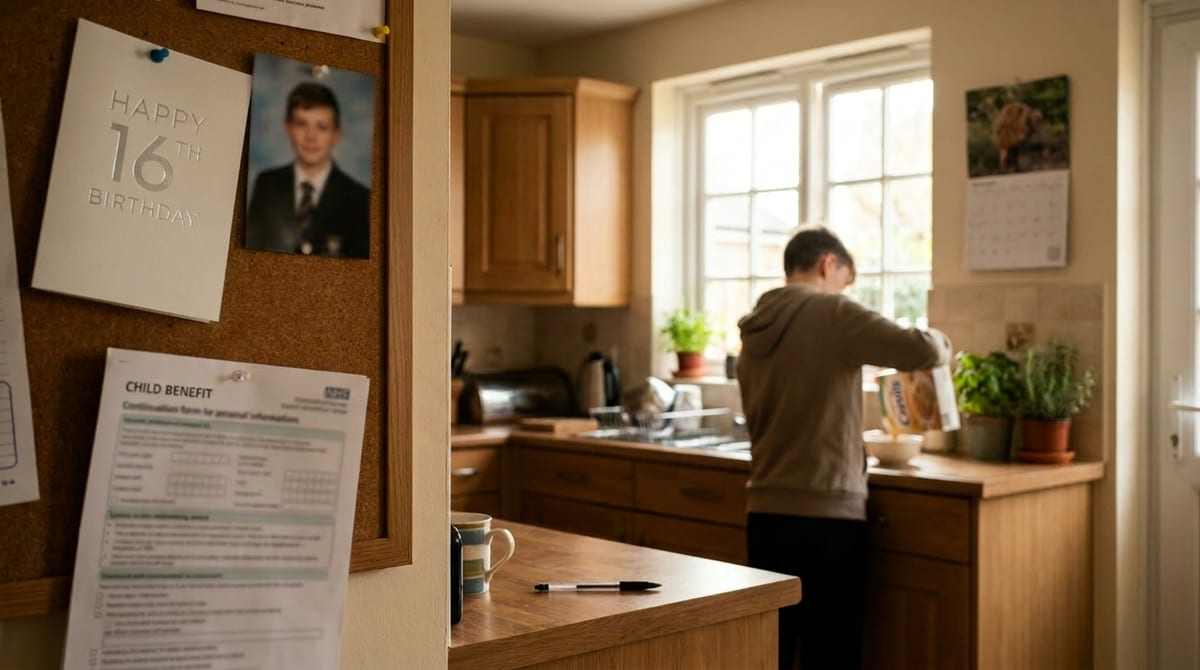
Your child turns 16. A few weeks later, Child Benefit stops. You didn’t realise you needed to tell His Majesty’s Revenue and Customs (HMRC) anything. By the time you notice, you’ve already lost money you can’t get back.
This happens to thousands of SEND families every year, and it can hit disabled young people hardest because the extra step is easy to miss. Since September 2025, a disabled young person no longer needs 12 hours of supervised study a week to qualify: any amount of education appropriate to their circumstances now counts. You still have to tell HMRC yourself, or the payments stop regardless of how few hours count.
The cliff edge at 16
Child Benefit doesn’t automatically continue when your child turns 16. HMRC requires you to actively notify them that your child is staying in education. If you don’t, payments stop.
The form you need is CH297. You can submit it online at gov.uk/child-benefit-16-19 or call HMRC on 0300 200 3100. The deadline is 31 August after your child’s 16th birthday.
HMRC can only backdate Child Benefit by up to 3 months from when they receive your notification. If you miss the deadline by more than 3 months, that money is gone. Don’t wait.
The September 2025 change for disabled young people
Before September 2025, Child Benefit required at least 12 hours of supervised study per week. Many disabled young people couldn’t meet that threshold.
From 1 September 2025, the rules changed. The Child Benefit (Miscellaneous Amendments) Regulations 2025 removed the 12-hour minimum for disabled young people. Now education for “any amount of hours appropriate for that person’s individual circumstances” qualifies.
| Before September 2025 | From September 2025 +Improved | |
|---|---|---|
| Minimum study hours | 12 hours/week supervised study | Any amount appropriate for the individual |
| Disabled young people | Must meet 12-hour threshold | Qualify even with fewer hours |
| Evidence needed | Proof of education programme | Proof of education plus evidence that fewer hours is appropriate for their circumstances |
This means a young person with SEND who can only manage 6 hours of study per week now qualifies for Child Benefit, as long as that’s the maximum appropriate for their circumstances.
Current rates
From April 2026, benefit rates increased by 3.8%. The eldest or only child receives £27.05 per week, with each additional child receiving £17.90 per week.
Why the UC knock-on matters
Losing Child Benefit doesn’t just cost you the weekly payment. If you’re on Universal Credit (UC), it can also trigger the loss of:
- The UC child element (£351.88/month for a first child born before 6 April 2017; £303.94/month for a first child born on or after 6 April 2017 and for additional children)
- The disabled child addition (£164.79/month for lower rate, £514.71/month for higher rate)
Not sure how these elements interact in your situation? The free assistant at SEND Parents Help can walk through your specific UC and Child Benefit setup.
These additional elements depend on your child being classed as a “qualifying young person” under Universal Credit’s own rules, a similar but legally separate test from the Child Benefit one. In practice, the same change, your child leaving approved education, for example, usually ends both Child Benefit and these UC elements together. Whether your teenager can claim Universal Credit in their own right while still in education is a separate question again.
The combined monthly loss can reach £984 or more. That’s over £10,000 a year.
Report your child’s DLA or PIP award to DWP if you’re on Universal Credit. This is a separate step from notifying HMRC about Child Benefit. The DLA award triggers both the disabled child addition and potentially the carer element in UC.
What counts as approved education
For Child Benefit to continue, your child must be in one of these:
- A Levels, T Levels, International Baccalaureate
- GCSEs (if resitting post-16)
- NVQs and vocational qualifications up to Level 3
- Study programmes in England
- Home education (from September 2025, no longer requires starting before age 16)
- Supported internships (where the young person is not paid)
Standard paid apprenticeships don’t qualify. If your child starts a paid apprenticeship, Child Benefit stops.
There’s also an upper age limit. Child Benefit can continue up to your child’s 20th birthday, but only if they started, or were accepted or enrolled onto, their course or training before turning 19. Once that window closes, a new claim cannot start even if they’re still studying.
The 20-week extension
If your child leaves education at 16 or 17 without starting another programme, a 20-week extension is available. Your child must work fewer than 24 hours per week, register with a government-sponsored careers service, and not be claiming certain benefits themselves, including Universal Credit.
Apply within 3 months of leaving education. Payments stop early if the young person starts full-time paid work, starts university, or turns 18.
Two transitions, two deadlines
The Disability Living Allowance (DLA)-to-Personal Independence Payment (PIP) transition and the Child Benefit extension both happen around your child’s 16th birthday, but they are completely separate processes. Child Benefit is managed by HMRC using Form CH297 with a deadline of 31 August after your child’s 16th birthday. If you miss this deadline, payments stop and backdate is limited to 3 months. The PIP transition is handled by DWP: your child must claim PIP by the date given in their invitation letter, or DLA is suspended, though a further 28-day window lets them still claim PIP and restore it without a gap. Miss that too, and DLA stops for good. See our DLA to PIP at 16 guide for the full timeline.
Don’t assume action on one covers the other. Manage them separately.
Getting help
HMRC Child Benefit helpline (0300 200 3100) can confirm your child’s status and help with Form CH297.
Citizens Advice can run a full benefits check to make sure you’re not losing money elsewhere when Child Benefit changes.
Contact (0808 808 3555) advises on all benefit transitions at 16, including both Child Benefit and DLA to PIP.
Don’t let it stop by accident
Child Benefit at 16 isn’t complicated. But the consequences of missing the notification are severe. One form, submitted on time, can protect over £10,000 a year in total household income.
If your child is approaching 16, submit Form CH297 now. If payments have already stopped, contact HMRC immediately. You may still be able to recover up to 3 months of missed payments.