

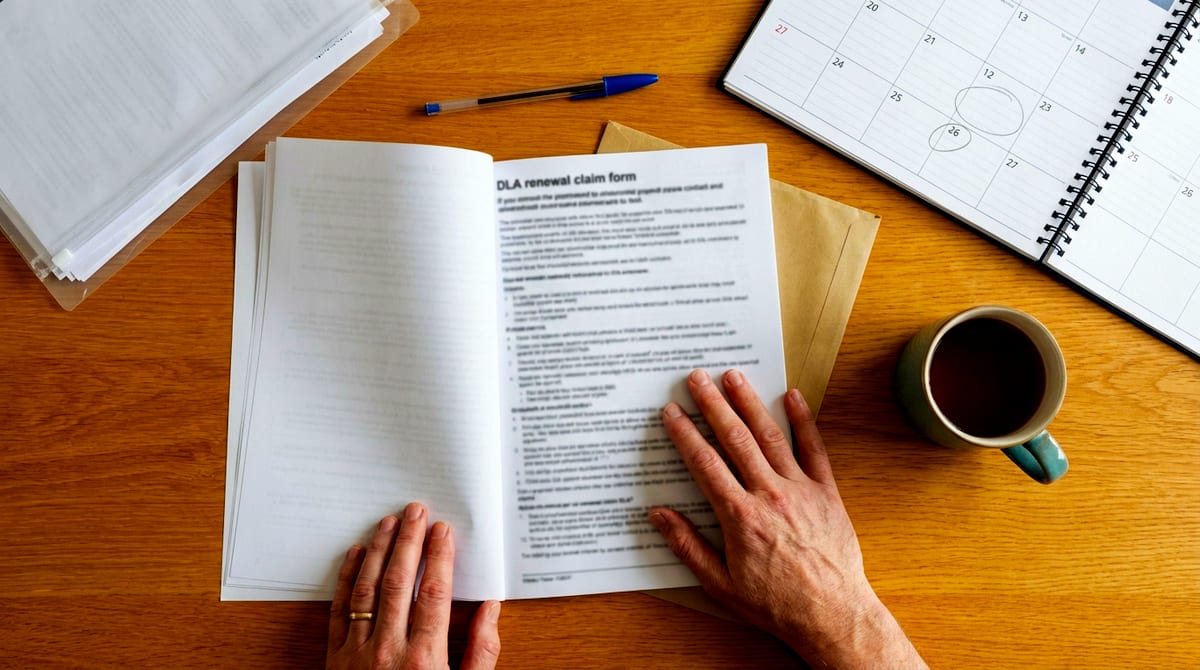
Once your child has a Disability Living Allowance (DLA) award, you have a legal duty to tell the Department for Work and Pensions (DWP) when things change. Many awards are time-limited too, so there’s usually a renewal to catch before it lapses. Neither is obvious, and nobody hands you a manual for the admin that comes after an award.
Reporting a change to your child’s DLA is a legal duty: phone the DWP on 0800 121 4600. DLA can’t be backdated, though your claim runs from the day you call. The qualifying period is three months of past need plus six forward, and a decision normally takes up to three months.
DLA for children applies in England and Wales. If your child lives in Scotland, the equivalent is Child Disability Payment, which has its own rules. This guide is written for families in England.
Key facts
- DLA is for children under 16, and the DWP runs it. At 16, your child is invited to claim Personal Independence Payment (PIP) instead.
- Reporting a change of circumstances is a legal duty. You could be taken to court or pay a penalty if you don’t report one.
- DLA can’t be backdated, but your claim runs from the day you call, not the day the form arrives, if you return it within six weeks.
- The qualifying period is three months of past need plus six months of expected need.
- The DWP normally sends a renewal pack around 20 weeks before an award ends. Return it before the end date or payments can stop.
- A DLA award is a gateway. It can add the Universal Credit disabled child element, qualify a carer for Carer’s Allowance, and give an automatic Blue Badge.
How do you report a change to your child’s DLA?
You report a change by phoning the DLA helpline on 0800 121 4600 (Relay UK: 18001 then 0800 121 4600). This isn’t optional. The gov.uk changes-you-need-to-report page is blunt about it: you “must contact” the helpline when your child’s circumstances change.
The same page warns that you “could be taken to court or have to pay a penalty if you give wrong information or do not report a change in your child’s circumstances”. That obligation sits on you for as long as the award runs.
What counts as a change is wider than most parents and carers expect. It covers your child getting better or needing more help, and practical things like a house move.
- Personal details - a change of name, address, or your child’s doctor
- The help your child needs - their condition or the level of care or supervision gets better or worse
- Time in hospital or a care home - your child goes into hospital or a care home
- Going abroad - your child plans to go abroad for more than four weeks
- Residential school - your child goes into a residential school
- Detention - your child is imprisoned or held in detention
- Immigration status - your child’s immigration status changes, if they’re not a British citizen
- End of life - a medical professional says your child is nearing the end of life
- Moving to Scotland - your child moves to Scotland; DLA continues for up to 13 weeks after the move, but you must apply for Child Disability Payment as soon as possible or your payments could be affected
The hardest one to judge is the second item, a change in the help your child needs. You don’t have to report every small wobble, but you do have to tell the DWP about a genuine, lasting change, in either direction.
Reporting that your child needs more help can trigger a full look at the award, which can go down as well as up. Hiding a worsening isn’t an option, because not reporting a real change is unlawful. Get free welfare advice first so you go in prepared.
If your child goes into a care home that the local authority (the council, often shortened to LA) pays for, there’s a further rule. DLA stops after 28 linked days in local-authority-funded residential care, with gaps of fewer than 29 days treated as linked. That’s separate from the going-abroad trigger, which is simply about telling the DWP when a trip will last more than four weeks.
When does DLA renew, and can an award lapse?
The DWP usually sends a renewal pack around 20 weeks before an award ends, and you need to return it before the end date or payments can stop. Many awards are time-limited rather than permanent, so a pack landing on the mat says nothing about how your claim is going. The DWP is checking whether the help your child needs is still there.
DLA awards come in two shapes. Some are fixed-term, lasting a set period before they need renewing. Others are indefinite, where the payment is ongoing and there’s no end date to chase. Which one your child gets depends on their needs. There’s no fixed band of years on gov.uk, so don’t assume an award lasts a particular number of years.
Scope’s guidance on DLA renewals warns that you could miss out on payments if you return the form after the end date. A gap stops DLA, and it can stop any Carer’s Allowance that depends on that award. Some families only find out when the Carer’s Allowance payment stops.
If your child’s award is getting close to its end date and no renewal pack has arrived, don’t wait. Phone the DLA helpline on 0800 121 4600 and ask for one. Returning the form before the current award ends is what protects you from a gap in payments.
A renewal has nothing to do with the annual rate rise. Each April, the DWP increases DLA rates automatically and you don’t need to do anything. The renewal decides whether the award carries on at all.
Can DLA be backdated?
No, DLA can’t be backdated. But your claim runs from the day you first phone the DWP, not the day the form arrives, as long as you return it within six weeks. The gov.uk how-to-claim page says DLA “can be paid from the start of your claim” and “cannot be backdated”.
The call date is what softens that. The same page says your claim “will start on the date the form is received or the date you call the enquiry line”, provided you return the claim pack within six weeks. Ring the helpline and that’s the date your claim is dated from.
If you download and print the form instead of calling, your claim only starts from the day the completed form is received, which can be weeks later. So call first, even if you’re nowhere near ready to fill anything in. You then have six weeks to gather professional letters and write clear descriptions, with your start date already protected.
How long does a DLA decision take?
A decision normally takes up to three months, with a letter confirming your claim was received within about three weeks of applying.
The gov.uk how-to-claim page says that after you apply, “you’ll get a letter within 3 weeks confirming your application”. That letter only tells you the form arrived. The decision comes later.
For the decision itself, gov.uk doesn’t publish a single timescale. Citizens Advice says you’ll normally get a decision letter within three months.
If you’ve heard nothing for a while, you can chase progress on the DLA helpline. Where a child is nearing the end of life, claims are dealt with urgently and the usual three-month qualifying period is set aside.
Three months is a long wait when money is tight. Phoning early won’t speed the decision up, but it does fix the date your claim runs from.
What is the DLA qualifying period?
Your child must have needed the extra help for at least the past three months and be expected to need it for at least the next six months. The gov.uk eligibility page states it directly: your child “must have had these difficulties for at least 3 months and expect them to last for at least 6 months”. That’s the backward and forward test.
There’s a comparison test alongside it. The same page asks whether your child needs “much more looking after than a child of the same age who does not have a disability”. Constant supervision is ordinary for a two-year-old and not for a ten-year-old, so age is what the DWP measures against.
| Status | Criterion |
|---|---|
| Note | Three months of past need Your child must have needed the extra help for at least the past three months |
| Note | Six months of expected need The help must be expected to continue for at least the next six months |
| Note | Compared with the same age Your child needs much more looking after than a child of the same age without a disability |
| Check | End-of-life exception A child nearing the end of life doesn’t need to have had the difficulties for three months |
You can apply during that first three months. Payment won’t start until the past-need threshold is met, so there’s nothing to gain by waiting.
If your child is nearing the end of life, the gov.uk eligibility page confirms the three-month past-need rule doesn’t apply. These claims are handled quickly and the qualifying period is waived.
The mobility component has its own age thresholds on top of the qualifying period. The higher rate is payable from age three, and the lower rate from age five. The DWP usually sends a claim pack ahead of each of those birthdays.
If you get DLA, what else can you claim?
A DLA award is a gateway, so it can add the Universal Credit disabled child element, qualify a carer for Carer’s Allowance, and give an automatic Blue Badge. For a lot of families, the weekly payment turns out to be the smaller part of what the award is worth.
Universal Credit comes first. A child on any rate of DLA adds the disabled child element to a Universal Credit claim, worth £164.79 a month. If your child gets the highest rate of the care component, that rises to the higher amount of £514.71 a month, confirmed on the gov.uk Universal Credit page. Our guide to the Universal Credit disabled child additions explains how to report a DLA award so the addition is added.
Then Carer’s Allowance. You may qualify if your child gets the middle or highest rate of the care component and you spend at least 35 hours a week caring for them. The gov.uk Carer’s Allowance eligibility page lists “Disability Living Allowance - the middle or highest care rate” as a qualifying benefit. The lower rate of care doesn’t pass this gateway. Our Carer’s Allowance guide for SEND parents and carers walks through the earnings limit and how to claim.
| DLA rate that opens it | What it opens up | |
|---|---|---|
| Any rate of DLA | Triggers | UC disabled child element, £164.79/mth |
| Highest rate care | Triggers | UC higher addition, £514.71/mth |
| Middle or highest care | Plus 35 hrs/week caring | Carer’s Allowance gateway |
| Higher rate mobility | Triggers | Automatic Blue Badge, no further assessment |
The Blue Badge is the simplest of the three. A child who gets the higher rate of the mobility component is automatically eligible, with no separate assessment, as the gov.uk Blue Badge guidance confirms.
Rates checked June 2026 against the gov.uk Universal Credit rates and the benefit and pension rates 2026 to 2027. For how DLA itself maps onto a child with physical needs, see our guide to claiming DLA for cerebral palsy and physical needs.
How do you change an existing award (supersession)?
If your child’s needs have changed, you can ask the DWP to look at the award again at any time by phoning 0800 121 4600. This is called a supersession. Be aware that the DWP reviews the whole award, so it can go down as well as up. It’s the right route when a fixed-term award no longer matches the reality of your child’s day.
The DWP doesn’t only look at the part that has worsened. It can reconsider the entire award, so a request meant to lift the care rate could also affect the mobility rate, or the other way round. That’s rare when needs have genuinely increased, but it can happen.
This is why free welfare-benefits advice is worth getting before you ask. An adviser can look at the whole picture, help you evidence the change, and tell you honestly whether a supersession is the right move. Our main guide to applying for DLA covers how to evidence needs in the same level of detail.
One more thing to watch is the cut-off at 16. DLA for children ends there, and your child is invited to claim Personal Independence Payment (PIP) instead, which has its own separate test. So once your child is 16 or older, the question is usually the move to PIP rather than a fresh DLA supersession. Our guide to the DLA to PIP transition at 16 covers how that handover works.
Getting help
You don’t have to manage this on your own. Several organisations offer free, expert support with DLA admin, and a quick call before you report a change or send back a renewal can save real trouble.
- Cerebra runs a DLA support service for families of children with brain conditions, including help with the claim and renewal forms.
- Scope has a free helpline and clear guidance on DLA renewals and changes of circumstances.
- Contact supports families with disabled children and has practical guides to DLA and the wider benefits system.
- Citizens Advice has trained advisers who can help you report a change, prepare a renewal, or challenge a decision.
- IPSEA (Independent Provider of Special Education Advice) gives free legal advice on SEND and how benefits interact with education support.
- Your local SENDIASS (SEN and Disabilities Information, Advice and Support Service) offers free, impartial advice across education, health, and social care.
You can also call the DLA helpline on 0800 121 4600 to report a change, request a renewal pack, or ask about your child’s award.