

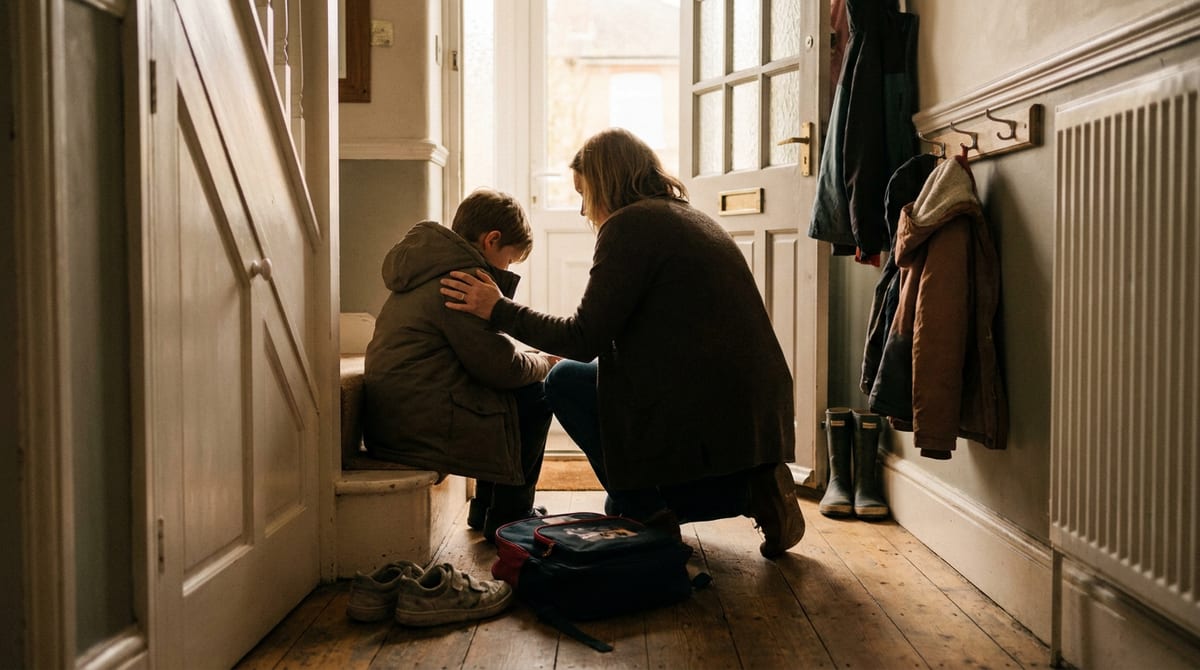
Your child used to go to school. Maybe not happily, but they went. Now they can’t. The anxiety is overwhelming. The meltdowns start the night before. The mornings are a battle that leaves everyone in tears.
And then the letters arrive. “Your child’s attendance has fallen below 90%.” Warnings about penalty notices. Threats of prosecution.
Emotionally Based School Avoidance (EBSA) isn’t truancy, and the law treats it differently, even if schools sometimes don’t. If your child’s absence is because of a disability or health condition, attendance fines shouldn’t apply and the school must consider reasonable adjustments before any enforcement. You are far from alone in this: more than a third of children with an EHCP were persistently absent last year. The local authority has a legal duty under Section 19 of the Education Act 1996 to arrange alternative education, and government guidance says it should act once it’s clear your child will be off for more than 15 days.
What is EBSA?
Emotionally Based School Avoidance is when a child cannot attend school due to emotional distress, typically anxiety connected to unmet needs. It’s distinct from truancy, where a child chooses not to attend.
| EBSA | Truancy | |
|---|---|---|
| Cause | Emotional distress, anxiety, sensory overload, unmet needs | Choice or disengagement |
| Child’s response | Distressed, fearful, physical symptoms (nausea, headaches, panic) | Absent but not distressed about missing school |
| What helps | Therapeutic support, reasonable adjustments, addressing root causes | Attendance strategies, mentoring, engagement |
| Legal framing | Medical or disability-related absence | Unauthorised absence |
The distinction matters legally. When absence is caused by a disability or health condition, different rules apply. The right framing makes all the difference: instead of asking “why won’t my child go to school?”, ask “what is happening at school that makes my child unable to go?” This shift from behaviour to environment is where your legal protections begin.
Attendance fines shouldn’t apply
Since the Department for Education’s August 2024 changes to the penalty notice framework, rates are £80 (within 21 days) or £160 (within 28 days) for a first offence. A second offence is £160 with no discount. A third offence within three years can’t be issued as another penalty notice; instead, the LA is expected to consider prosecution or another legal route.
But these penalties are designed for unauthorised absence, not for disability-related non-attendance.
If your child has a recognised condition (autism, ADHD, anxiety disorder, or another disability) and their absence is connected to it, you have strong legal protections.
Under Section 444 of the Education Act 1996, a parent cannot be convicted if the child’s absence was due to sickness or unavoidable cause. Anxiety and mental health conditions qualify. The Equality Act 2010 also requires the school to make reasonable adjustments before resorting to enforcement if your child has a disability. And the headteacher can and should authorise disability-related absences without triggering attendance penalties.
You have statutory defences available. Understanding them is your first line of protection against enforcement action.
Get medical evidence as early as possible. A GP letter stating your child cannot currently attend school due to their condition is sufficient. The LA cannot demand consultant-level evidence as a gateway to support.
The school’s duty: reasonable adjustments
Before any enforcement happens, the school should be asking what it can change. Under the Equality Act 2010, schools must make reasonable adjustments for disabled pupils.
For EBSA, reasonable adjustments might include:
- A reduced timetable with a gradual reintroduction plan (agreed, not imposed)
- A quiet arrival time before other pupils
- A safe space or named adult for when anxiety escalates
- Modified curriculum or alternative activities for high-anxiety subjects
- Breaks from the classroom as needed
- A communication plan so you can alert the school to difficult mornings
If the school hasn’t tried any adjustments and moves straight to enforcement, that’s likely a failure in its duties.
Section 19: the LA’s duty to provide education
When your child cannot attend school, the local authority has a legal duty to provide alternative education. This is set out in Section 19 of the Education Act 1996.
The duty requires full-time education unless part-time is better for the child’s health. “Full-time” means equivalent to mainstream school hours (roughly 21-25 hours per week).
Many families are offered 5 hours of home tuition per week. This is not full-time. Unless the child’s health requires a reduced programme, you can challenge it.
Request Section 19 provision in writing. IPSEA has a template letter (Template Letter 22) that you can use. Include your medical evidence and state clearly that your child cannot attend their registered school.
EOTAS: Education Otherwise Than At School
By the time you’re reading this, another forced school morning may be doing your child more harm than good, and that’s the situation EOTAS is built for. If your child has an EHCP and the LA agrees that a school placement would be inappropriate for them, it can arrange Education Otherwise Than At School (EOTAS) under Section 61 of the Children and Families Act 2014. This might include:
- Home tuition from qualified teachers
- Online learning programmes
- Tutoring centres or alternative provision settings
- A combination of approaches built around your child
EOTAS provision is recorded in Section F of the EHCP, with Section I left without a school named since no school placement is involved. If the LA agrees your child needs it, request that the EHCP is amended to reflect this.
CAMHS and crisis pathways
If your child’s anxiety is severe, request a referral to Child and Adolescent Mental Health Services (CAMHS). CAMHS can provide:
- Assessment and diagnosis of anxiety disorders
- Therapeutic interventions (CBT, counselling)
- Crisis support if your child’s mental health deteriorates
- Reports and letters that serve as evidence for school and LA
CAMHS waiting times vary significantly by area. If the wait is long, ask your GP about local voluntary sector support and whether a private assessment might be quicker.
How to prevent prosecution
If you’re receiving enforcement letters or penalty notices:
- Get medical evidenceA GP letter stating your child cannot attend school is sufficient. The Local Authority (LA) cannot demand a consultant’s letter.
- Write to the schoolState that absences are disability or health-related and must be authorised. Reference the Equality Act and reasonable adjustments.
- Request Section 19 provisionWrite to the LA requesting alternative education under Section 19 of the Education Act 1996.
- Challenge any penalty noticeRequest withdrawal in writing as soon as possible, following your LA’s penalty-notice procedure. Provide medical evidence showing the absence was due to sickness or unavoidable cause.
- If prosecution proceedsYour statutory defence is sickness or unavoidable cause under s.444. Seek legal advice from IPSEA or a specialist education solicitor.
Working through these steps in order builds a strong protective case. Follow this sequence if enforcement letters arrive.
Do not accept an informal reduced timetable imposed by the school as a substitute for proper provision. If the school reduces hours without your agreement and without a formal plan, this may be an unlawful exclusion.
Getting help
IPSEA provides free legal advice on school attendance, Section 19, and EOTAS provision.
Your local SENDIASS can support you in meetings with the school and LA, and help you understand your options.
Not Fine in School is a parent-led organisation specifically focused on school attendance difficulties, with resources for families dealing with EBSA.
Young Minds (parents helpline 0808 802 5544) offers advice on children’s mental health and accessing support.
Your child isn’t choosing this
EBSA is distress, not choice, and the law recognises that: disability-related absence calls for support, not a penalty notice.
If your child can’t attend school, the system has duties it must meet: reasonable adjustments from the school, alternative education from the LA, and protection from prosecution when absence is unavoidable.
Document everything. Get medical evidence early. And don’t accept enforcement when your child needs support.