

Schools have clear legal duties under the Children and Families Act 2014 and the Equality Act 2010 to support children with SEN. If they’re not meeting those duties, there are steps you can take, and they start with a conversation, not a fight.
Start with the SENCO
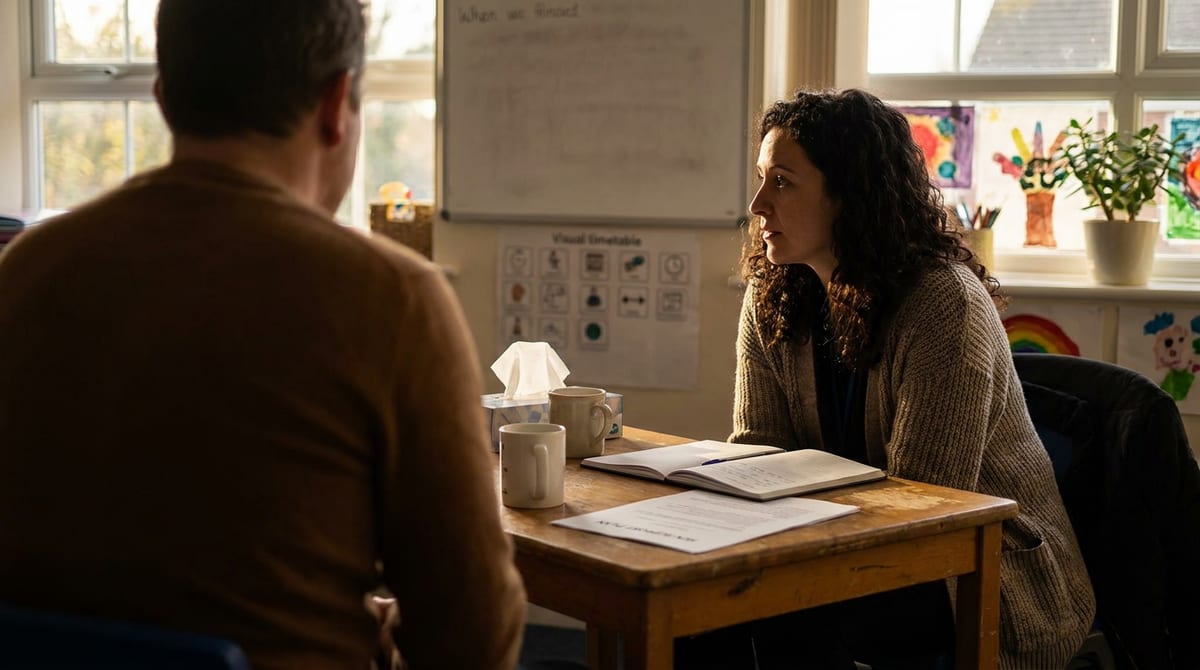
Before going formal, make sure you’ve spoken directly to the school’s Special Educational Needs Coordinator (SENCO). Sometimes class teachers agree to support that doesn’t reach the SENCO, or the SENCO has put plans in place that haven’t filtered down to the classroom.
Request a meeting with the SENCO and be specific about what’s not working:
- “The support plan says my child should have 15 minutes of reading intervention daily. The teacher says this hasn’t been happening.”
- “My child was supposed to be moved to a seat at the front. They’re still at the back.”
- “The emotional regulation strategy we agreed on isn’t being used when my child becomes distressed.”
Specific examples are harder to dismiss than general concerns. Bring dates and details.
Follow up every verbal conversation with an email. “Thanks for the meeting on [date]. Just to confirm, we agreed that [specific action] would happen by [date].” This creates a written record.
If the SENCO isn’t responsive
If the SENCO doesn’t respond, doesn’t follow through, or dismisses your concerns, escalate to the headteacher. Write a letter or email that sets out:
- What your child’s needs are
- What support has been agreed or should be in place
- What’s actually happening (or not happening)
- What you’re asking for
Reference the SEND Code of Practice and the school’s legal duty under Part 3 of the Children and Families Act 2014. This signals that you know your rights without being confrontational.
Make a formal complaint
If informal approaches haven’t worked, every school has a formal complaints procedure. You can usually find it on the school’s website.
- Informal resolutionSpeak to class teacher and SENCO. Put concerns in writing.
- Formal complaint to headteacherWrite a formal complaint setting out the issue and what you want done.
- Complaint to governorsIf the headteacher’s response doesn’t resolve it, escalate to the governing body.
- Complaint to the LAIf the school isn’t meeting statutory duties, you can raise this with the local authority’s SEN team, though LA oversight of individual schools is limited and this step does not always resolve the issue.
- Complaint to the DfEIf the school’s own procedure, including the governors, hasn’t resolved it, you can complain to the Department for Education. This applies whether the school is council-maintained or an academy.
The Local Government and Social Care Ombudsman looks at faults by the local authority, not the school, such as the LA failing to act on its own SEN duties, and only comes into play once you’ve exhausted the LA’s own complaints process.
Not sure whether what’s happening counts as a failure to make reasonable adjustments or something more serious? Describe the situation to our free assistant and it will help you identify the right path.
When disability discrimination applies
If your child has a disability (which includes many SEND conditions), the Equality Act 2010 applies to schools. Schools must not discriminate against disabled pupils, and they have a duty to make reasonable adjustments.
You don’t need to name the exact type of discrimination before you complain, but it helps to recognise the pattern:
Direct discrimination - treating your child less favourably because of their disability. For example, excluding them from a school trip because of their condition.
Discrimination arising from disability - treating your child unfavourably because of something connected to their disability, rather than the disability itself. For example, a behaviour policy that punishes all children equally for behaviour that’s a manifestation of a disability.
Failure to make reasonable adjustments - not changing practices or policies that put disabled children at a substantial disadvantage. For example, refusing to allow movement breaks for a child with ADHD who can’t sit still for an hour.
If you believe your child has been discriminated against, you can bring a claim to the SEND Tribunal within 6 months of the incident.
What schools can’t do
- Informal exclusions - sending your child home to “cool down” without formal paperwork is unlawful. Every removal from school must follow the formal exclusion process.
- Reduced timetables without agreement - if the school puts your child on a part-time timetable, this should be a temporary measure agreed with you (and the LA too, if your child has an EHCP), with a clear plan to return to full time.
- Refusing to implement an EHCP - if your child has an EHCP, the local authority has an absolute legal duty to secure the provision in Section F, and the school delivering it can’t point to funding or staffing shortages as an excuse. “We don’t have the resources” is not a valid reason.
- Refusing to make reasonable adjustments - the duty applies unless the adjustment would be unreasonable, and cost is one of the factors in deciding that.
If the school is regularly sending your child home informally (no paperwork, no formal suspension), keep a record of every instance. This is unlawful exclusion and should be reported to the LA and governors.
Getting help
Your local SENDIASS can attend meetings with you, help you draft complaint letters, and explain your options at each stage.
IPSEA provides free legal advice on school duties, disability discrimination, and how to escalate complaints.
Coram Children’s Legal Centre offers advice on education law and school complaints.
You’re not being difficult
Start with a conversation. Follow up in writing. Escalate if you need to.