

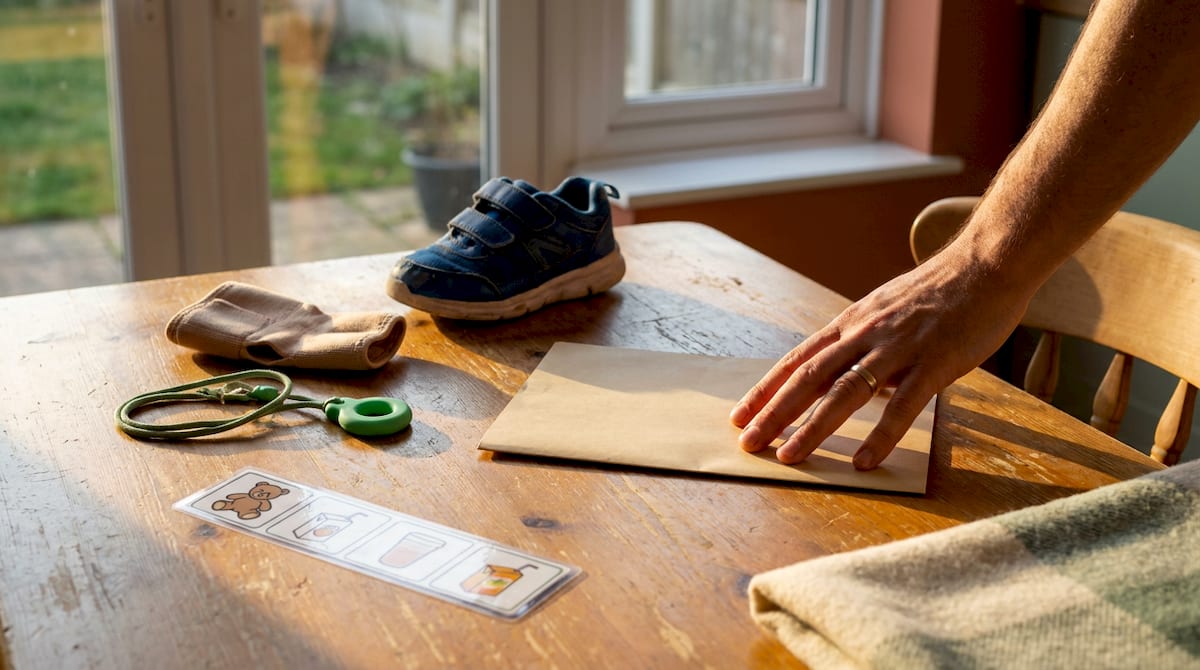
You’re at the kitchen table with the DLA claim form and the leaflet’s list of example conditions. Autism. ADHD. Cerebral palsy. Down’s syndrome. You read it twice, because your child’s diagnosis isn’t there. Dyspraxia isn’t there. Neither is joint hypermobility, or Avoidant/Restrictive Food Intake Disorder (ARFID), or Tourette’s syndrome, or the moderate learning difficulty the school flagged last term, or the speech delay nobody has quite explained yet. You start to wonder whether the form is telling you something: maybe this isn’t the kind of thing that qualifies.
It isn’t telling you that. Any list of example conditions is just that, a sample, not a checklist of who is allowed to apply. Disability Living Allowance (DLA) has never been awarded for a diagnosis. It’s awarded for the extra care and supervision your child needs compared with a child the same age who doesn’t have their condition, whatever that condition is called, and however unfamiliar it looks against a form built around a handful of named examples.
That’s genuinely good news, because it means the absence of a box doesn’t mean the absence of a claim. It does mean you have to do more of the translating yourself: turning “he’s clumsy”, “she’s a fussy eater” or “he ticks” into the specific, quantified, same-age-compared detail a Department for Work and Pensions (DWP) decision-maker is trained to score. This guide is about that translation, for parents and carers of children whose condition doesn’t come with a well-worn claim path already written for them.
Key facts
- DLA is for children under 16 in England. At 16 your child moves to Personal Independence Payment (PIP).
- It’s not means-tested and not taxed, and there’s no list of qualifying diagnoses. The form’s example conditions are illustrative, not exhaustive.
- The test is comparative: your child must need substantially more help or supervision than a child the same age who doesn’t have their condition.
- There are two components, each with its own rates: care (three rates) and mobility (two rates). A child can get one, both, or neither.
- The DWP’s own medical guidance for decision-makers names dyspraxia, joint hypermobility, speech and language disorders and learning disability specifically, alongside more commonly claimed conditions.
- The highest possible weekly award in 2026 to 2027 is £194.60 (highest care plus higher mobility).
Why there’s no box for your child’s condition
Every DLA claim form has the same design problem: hundreds of possible childhood conditions, and a page or two of examples. Those examples exist to jog your memory, not to gatekeep your claim. If your list didn’t mention dyspraxia, hypermobility, ARFID, Tourette’s, moderate learning difficulties or speech delay, that’s a limitation of the printed page, not a judgement on your child.
The legal question underneath the form is the same for every condition, named or not. Section 72 of the Social Security Contributions and Benefits Act 1992 sets the test for the care component and section 73 for mobility, and both ask a version of the same thing: does your child need substantially more help than a child the same age who doesn’t have their condition? The gov.uk eligibility guidance puts it plainly: your child needs to “need much more looking after than a child of the same age who does not have a disability.”
The diagnosis on the letter isn’t the test. A decision-maker scores the help you actually give, not the name of the condition that makes it necessary. Two children with the same diagnosis can get very different awards, and two children with completely unrelated diagnoses can both meet the same rate, because what matters is the care and supervision, not the label.
| Status | Criterion |
|---|---|
| Note | - Attention - active help a same-age child would not need Step by step prompting through dressing or washing, sitting with your child through every meal, physiotherapy or stretches at home, working out what’s behind a tic or meltdown and helping them through it |
| Note | - Supervision - watching over to prevent real danger Staying within arm’s reach because your child has no road sense, watching for a fall on stairs or furniture, being ready to step in when a tic, impulse or shutdown could hurt them or someone else |
Your child’s needs also have to last, whatever the diagnosis: a backward test (needs present for at least 3 months before you claim) and a forward test (expected to continue for at least 6 months). For a long-term condition like the ones in this guide, both are usually straightforward to satisfy.
What DLA is worth from April 2026
DLA rates rose by 3.8% on 6 April 2026, under the Social Security Benefits Up-rating Order 2026. The amount your child could get depends on which rate of each component they’re awarded.
| Component | Rate | Weekly amount (2026 to 2027) |
|---|---|---|
| Care | Lowest | £30.30 |
| Care | Middle | £76.70 |
| Care | Highest | £114.60 |
| Mobility | Lower | £30.30 |
| Mobility | Higher | £80.00 |
A child awarded highest rate care and higher rate mobility gets £194.60 a week. The two components are decided separately, so it’s common to be awarded one and not the other. For the full claim process from first phone call to posting the form, see our guide to applying for DLA step by step.
Describe an ordinary day, not the best one or the worst
This is where claims for less familiar conditions are won or lost. Parents describing autism or ADHD have years of other people’s phrasing to borrow from. If your child has dyspraxia, hypermobility, ARFID or a speech delay, you’re often starting from a blank page, and a blank page tends to produce vague, general sentences that a decision-maker can’t score.
The fix is specificity: what happened, how often, for how long, and what would happen if you weren’t there. “He struggles with fine motor skills” tells a decision-maker nothing. “He can’t do up his own buttons or use scissors safely at nine, so I dress him and cut up his food every day” tells them exactly what to score.
| Too vague to score | Specific enough to score | |
|---|---|---|
| Dyspraxia and dressing | He struggles to get dressed | He needs prompting for every fastening, every day. Left alone he stays in his pyjamas. |
| Hypermobility and walking | Her joints hurt sometimes | She can walk to the corner shop but not back. I carry her the last 200 metres most days. |
| ARFID and mealtimes | He’s a fussy eater | He eats four foods. I prepare a separate meal at every sitting and stay with him throughout, or he eats nothing. |
| Tourette’s and safety | He has tics | His tics include hitting his own head. I stay within reach whenever he’s tired or stressed, most evenings. |
| Speech delay and frustration | She gets frustrated when she can’t talk | She has no words for pain or fear, so I use a picture chart with her most days to work out what’s wrong. |
| Moderate learning difficulty and danger | He doesn’t understand things as well as other children his age | At nine, he still walks into roads without stopping, the way a much younger child would. |
Describe a typical day, including the help that’s become so routine you’ve stopped noticing it. That morning routine that takes forty minutes longer than it does for other families belongs on the form.
When your child’s condition is different day to day
Hypermobility, Tourette’s and speech and language needs rarely sit still. A child with joint hypermobility might walk two miles on a good day and need carrying after fifty metres the next, once fatigue and pain build up. Tics wax and wane over weeks, often worse under stress, better on holiday, then worse again once term starts. A child’s speech might leap forward for a month and then plateau.
Describe a normal-to-hard day, not a rare good one. If your child manages a calm ten-minute clinic appointment but falls apart by 5pm most days, the appointment isn’t the evidence. The 5pm collapse is.
Decision-makers understand that conditions fluctuate, but only if you tell them. Note the pattern: how many days a week are hard, what a hard day actually involves, and what you do differently on those days. A hypermobile child who needs a wheelchair for school trips but not the walk to the corner shop isn’t inconsistent. That’s exactly what the evidence should say, because it’s the truth, and vague averaging out of good and bad days under-describes what your child actually needs.
Sensory and eating needs are care too
ARFID is a feeding and eating disorder recognised by the NHS, distinct from a picky phase: a child with ARFID avoids certain foods or food groups, eats only small amounts, or both, and unlike anorexia or bulimia, concerns about weight or shape aren’t the reason. It’s often driven by sensory sensitivity to taste, texture or smell, a fear of choking or vomiting, or simply very low interest in food, and it can affect a child’s growth, energy and concentration.
None of that shows up as a tidy line on the DLA form, so you have to build it. The attention is real: preparing separate meals, supervising every mealtime to prevent choking or refusal escalating, and managing supplement drinks. ARFID often sits alongside autism or sensory processing differences, so if that’s true for your child, describe both, because the care they generate stacks.
Quantify it. “He won’t eat much” is an observation. “He eats plain pasta, one brand of chicken nugget, and dry toast, and nothing else. I prepare and sit with him through three meals and two snacks a day, every day, or he eats nothing at all” is evidence.
Joint pain, fatigue and physio time
Joint hypermobility syndrome means a child’s joints move further than average, and the NHS notes this brings aches, fatigue “even after rest”, frequent sprains and strains, joints that dislocate or “pop out”, and poor balance or coordination. Symptoms often ease with age, but for a school-age child they can be constant.
For the care component, count the minutes: set stretches or exercises, help getting up from the floor or out of a bath, splints or supports to put on, pain relief and rest breaks built into the day. For mobility, the walking test under regulation 12 of the Social Security (Disability Living Allowance) Regulations 1991 looks at distance, speed, time and manner of walking without severe discomfort, which suits hypermobility well: a child can be capable of walking in theory and still be in genuine pain doing it.
If your child can walk 300 metres but is limping and in tears by the end, the legal walking ability is 300 metres in pain, not an abstract capability. Ask a physiotherapist or rheumatologist for a letter describing distance, flare-up frequency and what happens after activity, not just the diagnosis.
Supervision for danger you can’t always predict
Some of the hardest care needs to evidence are the ones with no obvious physical cause. Dyspraxia affects motor planning, so a child can fall on stairs, walk into furniture, or misjudge a kerb in a way a typical child their age wouldn’t, particularly when tired. Tourette’s tics are involuntary, and a small number involve movements that put a child at risk, from hitting themselves to sudden jerks near a road or a hot hob.
A moderate learning difficulty (MLD) or a significant speech and language delay can carry the same kind of risk from a different direction. The SEND Code of Practice places MLD within the cognition and learning area of need, meaning a child learns at a noticeably slower pace than same-age peers across the board, and that gap shows up outside the classroom too. A nine-year-old with MLD who still can’t reliably judge whether it’s safe to cross a road needs supervision a typical nine-year-old doesn’t, and that’s care in DLA terms, not an education issue. If you’re the one who still checks the road before they step off the kerb, every time, without being asked, that watching is exactly what belongs on the form.
Higher rate mobility through the Severe Mental Impairment route needs your child to already have highest rate care, a severe (not moderate) impairment of intelligence and social functioning, and extreme disruptive behaviour requiring physical restraint. It rarely fits dyspraxia, hypermobility, Tourette’s, or a moderate learning difficulty on its own. Build your mobility claim on guidance and supervision at the lower rate instead, where it usually belongs.
Be honest about the harder cases too. A mild speech delay that’s already resolving, or a moderate learning difficulty with no other needs, may not on its own generate care substantially in excess of a same-age child, because plenty of young children need some extra explaining and some extra watching. If your child’s speech or learning needs sit alongside safety risks, self-care gaps, or sensory needs, describe the whole picture rather than the label. The claim stands or falls on the total care needed, not on any one diagnosis carrying it alone.
Evidence that carries weight without a tick-box diagnosis
For a well-known condition, a diagnosis letter alone can carry a claim a long way. For the conditions in this guide, professional evidence usually needs to say more, because the reader may be less familiar with what the condition looks like day to day.
- A short diary of a normal day and a hard day, noting what help was given, when, and for how long
- Occupational therapy or physiotherapy reports for motor, coordination or joint-related needs like dyspraxia or hypermobility
- A dietitian, paediatrician or eating disorder service letter for ARFID, describing what’s actually eaten and what mealtimes involve
- A paediatrician or neurology letter for tics, describing frequency, type, and any injury risk
- A speech and language therapy or educational psychologist report for speech delay or a learning difficulty, describing the gap against same-age peers
- School or nursery evidence describing the support or supervision your child needs there
Ask professionals to describe what your child can’t do, not just what the condition is called. “Requires prompting for all fastenings and cannot use cutlery safely” scores. “Has dyspraxia” does not, on its own.
Mistakes that cost claims when the condition is unusual
A handful of avoidable errors come up again and again on claims for less commonly claimed conditions.
- Assuming no box means no claim. The form’s examples aren’t exhaustive, and the underlying test is the same for every condition.
- Leaning on the diagnosis instead of the day. “She has ARFID” or “he has dyspraxia” tells a decision-maker very little on its own.
- Averaging good days and bad days into one vague description. Fluctuating conditions need the range described, not a blurred middle.
- Forgetting supervision. Watching over a child to prevent a fall, a dangerous tic, or a road-safety risk is care, even when you never lay a hand on them.
- Comparing to other children with the same condition. The legal comparison is with a child the same age who doesn’t have it, not with children from a support group.
A refusal, or a lower rate than expected, is often about a description that was too general rather than a condition that doesn’t qualify. Our guide on what to do when a DLA application is rejected walks through mandatory reconsideration and appeal.
Getting help
You don’t have to work this out alone, and condition-specific charities often know exactly how their community’s needs map onto DLA language.
- Dyspraxia Foundation offers information, a helpline and local groups for families affected by dyspraxia.
- Hypermobility Syndromes Association (HMSA) supports people with symptomatic joint hypermobility through a helpline and patient information.
- ARFID Awareness UK supports people with ARFID, their families, and the professionals who work with them.
- Tourettes Action runs a helpdesk and support groups for people with Tourette syndrome and their families.
- Contact is a charity for families with disabled children, with a helpline and DLA guides covering conditions beyond the common ones.
- Your local SENDIASS (SEN and Disabilities Information, Advice and Support Service) gives free, impartial advice across education, health and social care.
Write down the day, not just the diagnosis
A condition that doesn’t fit neatly into a leaflet’s example list can still generate a strong DLA claim, because the form was never really testing the diagnosis. It’s testing the gap between what your child needs and what a same-age child without their condition needs. Dyspraxia, hypermobility, ARFID, Tourette’s, speech delay and moderate learning difficulties can all open that gap wide, in their own particular way.
Write down what an ordinary day actually costs you: the extra time, the extra watching, the extra explaining. That’s the evidence, whatever the form calls it, or doesn’t call it at all.