

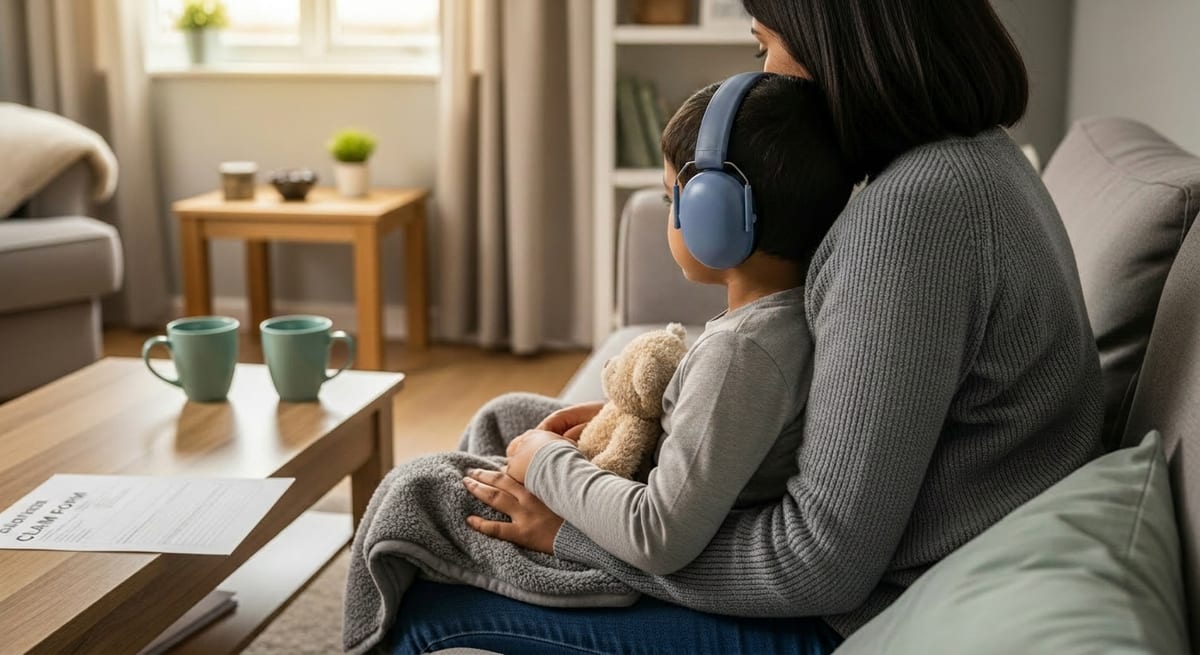
The morning routine that took an hour and a half. The meltdown in the supermarket because the fluorescent lights were too loud. The change of plans that derailed the whole afternoon. The night you spent on the floor of your child’s room waiting for them to settle, again. If you’re caring for an autistic child, you know that much of what you do is invisible: managing sensory overload, holding routines together, scripting social situations before you get there, staying calm so your child can borrow your calm.
Disability Living Allowance (DLA) exists to recognise that work. The benefit isn’t awarded for a diagnosis, so there’s no autism box that pays out. It’s awarded for the extra care and supervision your child needs compared with a child the same age who isn’t autistic. Parents and carers who can describe that help, in concrete daily terms, may have a strong claim, whether or not their child also has a learning disability.
DLA for children is tax-free, it’s not means-tested, and your income doesn’t matter. It has two parts: a mobility component and a care component. Many autistic children qualify for one or both. This guide is written for families in England; if your child lives in Scotland, Child Disability Payment covers the same ground under different rules. Eligibility is rarely the sticking point for an autistic child. The real work is getting an assessor at the Department for Work and Pensions (DWP), who has never met your child, to see a sensory meltdown, a wandering risk, or a silent, exhausting bedtime routine on the page.
Key facts
- DLA is for children under 16. At 16 your child is invited to claim Personal Independence Payment (PIP) instead; the move isn’t automatic.
- It’s not means-tested and not taxed. There is no autism-specific rate.
- The test is comparative: your child must need substantially more help than a child the same age without their condition.
- There are two components, each with its own rates. A child can get one or both.
- The highest possible weekly award in 2026 to 2027 is £194.60 (highest care plus higher mobility).
- A diagnosis is helpful evidence, but the form is scored on daily needs, not labels.
Can an autistic child get DLA?
There’s no autism entry on a checklist of qualifying conditions, because no condition gets one. Every claim comes down to the same legal question: does your child need substantially more attention or supervision than a child the same age who doesn’t have a disability? The DWP looks at function, not the diagnosis.
This is important to understand, because autism presents so differently from child to child. A child who is academically able and largely verbal can still need total routine management to get through the day. They can still be unable to eat anything outside a narrow list of safe foods without adult management at every meal. They can still hit meltdown from a noise they can’t filter, and need 45 minutes of adult co-regulation to come back. A child who holds it together at school may be saving every bit of that effort for home, which is where the real needs are, and where DLA needs to hear about it.
The diagnosis isn’t the test. Two autistic children can have very different awards, because their daily needs differ. Describe the help your child needs, not the label they carry.
Your child’s needs also have to last. There is a backward test (the needs have been present for three months before you claim) and a forward test (they are likely to continue for at least six months after). For a lifelong condition like autism, both are usually straightforward to satisfy.
How much is DLA worth in 2026?
DLA rates rose on 6 April 2026. The amount depends on which rate of each component your child is awarded. The care component has three rates and the mobility component has two.
| Component | Rate | Weekly amount (2026 to 2027) |
|---|---|---|
| Care | Lowest | £30.30 |
| Care | Middle | £76.70 |
| Care | Highest | £114.60 |
| Mobility | Lower | £30.30 |
| Mobility | Higher | £80.00 |
A child awarded highest rate care and higher rate mobility receives £194.60 a week. The two components are decided separately, so it is common to be awarded one and not the other. For the full claim process, see our guide to applying for DLA step by step, and for how the April uprating changed every rate, see what changed in the April 2026 benefit rates.
The mobility component and autism
The mobility component is about getting around outdoors, and it has two rates that work very differently for autistic children.
The lower rate (from age 5) is the one most autistic children claim. It is for a child who can physically walk but needs guidance or supervision outdoors, on unfamiliar routes, far more than other children their age. An autistic child who bolts into traffic, who has no sense of danger, who freezes or panics in unfamiliar places, or who can’t be trusted to walk safely without an adult holding on, fits this rate well. The test looks at unfamiliar routes, not the familiar walk to school, so describe how your child manages somewhere new.
The higher rate (from age 3) is harder to reach on autism alone. It is mainly for children who are physically unable to walk, or who meet the Severe Mental Impairment (SMI) criteria. SMI is a strict legal test: it requires a severe impairment of intelligence and social functioning, together with severe behavioural problems, and the child must already receive the highest rate of care.
Higher rate mobility through the Severe Mental Impairment route rarely fits an autistic child who doesn’t also have a significant learning disability. If your child is academically able, don’t count on it. Build a strong lower rate claim on guidance and supervision instead.
What counts as care for an autistic child?
This is where most autism claims go wrong. Not because parents understate the hands-on help, but because they leave out the rest: the pre-empting, the staying present, the mental load of keeping everything predictable enough that today doesn’t fall apart. DLA counts two different kinds of help, and for autistic children, understanding both changes the claim completely.
Attention is active help: doing something for or with your child that another child their age wouldn’t need. For an autistic child, that includes managing sensory overload before it tips into meltdown, scripting conversations before social situations, prompting through every step of a task their brain can’t sequence alone, and the hands-on work of co-regulating a child who is overwhelmed. Supervision is watching over your child to keep them safe from a real danger. Many autistic children have limited awareness of danger, bolt, or can’t be trusted near roads or water. Others need watching at night because they wander or leave the house. A claim that names only the active help misses half the picture, because so much of autism support is exactly that: being present, being ready, reading the warning signs before they become a crisis.
| Status | Criterion |
|---|---|
| Note | Attention - active help a same-age child wouldn’t need Talking your child down from a meltdown, prompting every step of getting dressed, sitting with them through every meal, managing sensory overload, explaining social situations they can’t read |
| Note | Supervision - watching over to prevent real danger Staying within reach near roads because they have no danger awareness, stopping them bolting, watching for self-injury or aggression, supervising around water, kitchens or stairs |
The key phrase the DWP uses is substantially in excess of the needs of a child the same age. All young children need supervision. The question is whether yours needs noticeably more, and for longer into childhood, than other children their age. A seven-year-old who still can’t be left alone in a room, or who needs an adult beside them every time they leave the house, needs supervision well beyond the norm for seven.
Describe a typical day, not your child’s best day or their worst day. Decision-makers want to know what help your child needs on an ordinary day, including the parts that have become so routine you have stopped noticing them.
Care needs autism often creates
It helps to translate everyday autistic needs into the form’s terms. Your child won’t have every item on this list, and none of it is unique to autism, but each one is the kind of need that builds a care award.
- Prompting and guiding through everyday tasks like dressing, washing and teeth, step by step, every day
- Help eating, including managing a very restricted diet, food refusal, or safety around choking and pica
- Constant reassurance and help regulating anxiety, sensory overload and changes to routine
- Talking through and physically managing meltdowns or shutdowns
- Interpreting the social world: explaining what people meant, why plans changed, what happens next
- Supervision for safety because your child has limited awareness of danger, bolts, or acts on impulse
Night-time needs and the highest rate
The highest rate of care is reserved for children who meet the middle rate criteria and have needs during the night. Autistic children very commonly do, and the reasons are specific to autism in ways worth spelling out on the form.
Many autistic children can’t fall asleep without an adult present: the anxiety of the transition, the sensory discomfort of bedclothes and darkness and quiet, the inability to switch off a brain that is still processing the day. Others fall asleep but wake repeatedly and can’t resettle without you. Some wander at night with no awareness of the risk: downstairs, outside, into the kitchen. If that is your child’s pattern, night-time isn’t incidental to your care needs. It’s central to them.
On the claim form, question 70 asks specifically about night-time, and the boxes are small. Use the free-text box at question 72 to set out the full picture: how often you are up, what you have to do, how long it takes, and what could happen if you weren’t there.
How to evidence autistic needs on the form
Autism claims tend to fail in a particular way on this form: not because parents hide the hard parts, but because routine dulls them. You’ve managed the morning routine so many times that you no longer notice it takes an hour longer than other families’. That hour belongs on the form.
Write as if the person reading has never met your child and has no idea what autism looks like in daily life. Don’t write “struggles with sensory issues.” Write what actually happens: “The school dining hall is too loud for her. I have to collect her early on Tuesdays when there is a special lunch because she cannot manage it and has a meltdown if I do not come. This has happened every week this term.” Don’t write “has difficulty with changes to routine.” Write: “When his usual bus did not come last month, he sat on the ground on the pavement and could not move. I had to call the school to explain. It took 40 minutes to get him home.” Use question 72, the big free-text box, to expand on everything the small boxes couldn’t hold, especially supervision and night needs.
- A few days of notes or a simple diary showing what help your child needed and when, including nights
- Professional reports: your child’s autism diagnosis, plus any from a paediatrician, occupational therapist, speech and language therapist, or educational psychologist
- A statement from school or nursery if staff can describe the support your child needs there
- Care and Mobility described in your own words at question 72, in concrete daily detail
- Any medication or therapy your child needs and the help they need to take it
Send copies, never originals, and keep a copy of the whole form before you post it. If you are awarded a lower rate than you expected, or refused, you can challenge it, and many autism claims succeed on appeal once the daily reality is properly described. Our guide on what to do when a DLA application is rejected walks through mandatory reconsideration and appeal.
Common mistakes that cost autism claims
Autism claims tend to trip over the same handful of mistakes.
- Comparing to other autistic children. The comparison is with a child the same age who isn’t disabled, not with your child’s friends from the autism group.
- Leaning on the diagnosis. “She is autistic” isn’t enough. “She needs an adult beside her every time we leave the house because she runs toward roads” is.
- Describing the best day. A child who can sometimes manage a task still needs help if they can’t manage it reliably, safely, or without prompting.
- Forgetting supervision. Hours of watching over to prevent danger is care, even when you never lay a hand on your child.
- Skipping the night. Settling, waking and night-time wandering are some of the strongest evidence for the highest rate, and they are the easiest to leave out.
Getting help
You don’t have to do this alone. Several organisations offer free, expert support with DLA claims for autistic children:
- Contact is a charity for families with disabled children, with a helpline and detailed DLA guides written for parents
- Cerebra publishes a well-regarded DLA guide and runs a helpline for families of children with neurological conditions, including autism
- Citizens Advice has trained advisers who can help you complete the form and prepare evidence
- National Autistic Society offers information on benefits and wider support for autistic people and their families
- Your local SENDIASS (SEN and Disabilities Information, Advice and Support Service) gives free, impartial advice across education, health and social care
These services are free and they understand the system. Asking for help before you submit can make a real difference.
The bottom line
A learning disability isn’t a precondition for an autism DLA claim, and neither is any particular diagnosis beyond autism itself. What decides it is the work: the routine management, the sensory navigation, the meltdown recovery, the night-time settling, the constant presence that keeps your child’s day from falling apart, work that stays invisible to everyone except you. That work is real. The form has space for it. Write it down in full.