

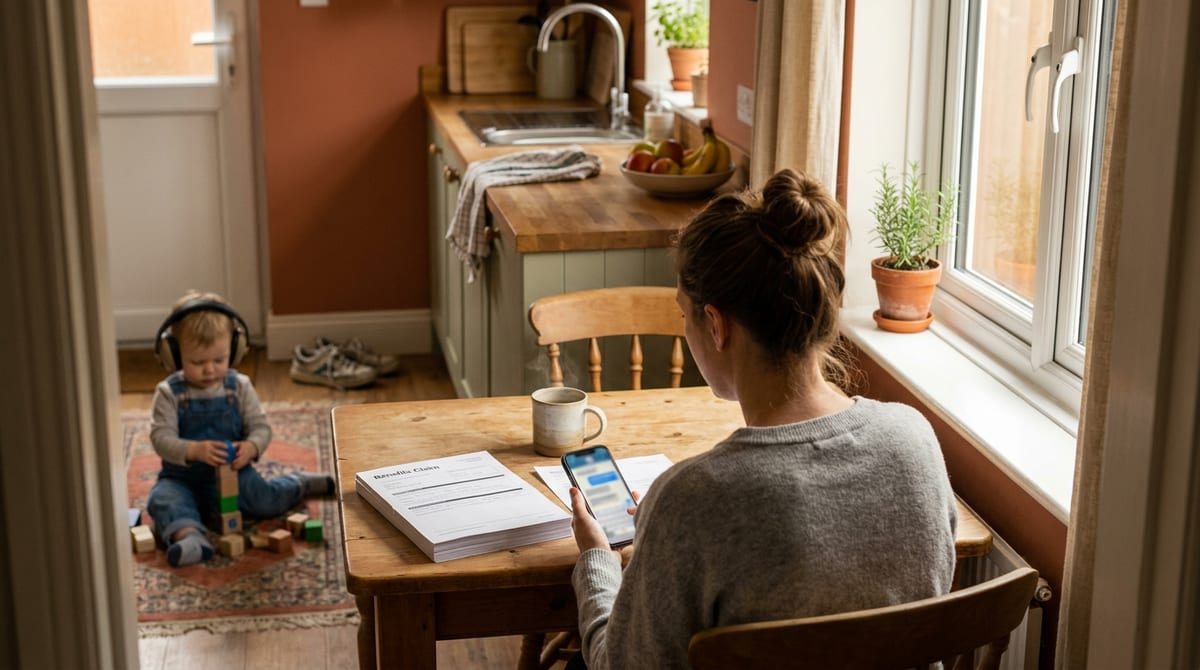
Work through the DLA form one section at a time with the free SEND Parents Help assistant, which knows the DLA1A claim form question by question and helps you turn rough notes about your child’s day into the specific, quantified answers a decision maker looks for.
The Disability Living Allowance (DLA) form asks you to write down your child’s hardest days across roughly 40 pages.
Start with this prompt
Open the assistant, paste this in, and fill in the brackets. It sets up the whole session and the same-age comparison that decision makers look for.
I’m filling in the DLA1A claim form for my child, who is [age] and has [diagnosis or main difficulties]. I want to work through it section by section, starting with [the section or question you’re on, for example question 54 about getting out of bed]. Here are my rough notes about this part of their day: [paste your notes or extracted text]. Help me describe the help they need clearly and specifically, with how often it happens and how long it takes, comparing them to a child of the same age without their condition. If my notes are missing detail you need, ask me questions before drafting anything.
One tap opens the assistant with this prompt ready. Edit the parts in [square brackets] once you are there. Prefer to do it by hand? Copy it and paste it in yourself.
Open the assistant with this prompt (opens ChatGPT)The assistant asks questions before it drafts, so a rough start is fine. New to ChatGPT? Our two-minute setup guide gets you a free account. If your evidence is on paper or in PDFs, our free Doc Tools page pulls the text out in your browser, with nothing uploaded, ready to paste in. Swap your child’s full name for initials before you paste in notes or reports; the assistant works just as well either way.
The three things that win a DLA claim
The form rewards specific, quantified description. “She struggles with mornings” gets refused. “I dress her every morning, which takes 20 minutes, because she can’t manage any fastenings” gets taken seriously. As you work through each section with the assistant, keep three habits:
- Describe the hardest days, not the average. The decision-maker looks at the whole pattern of good and bad days, so a “good day” answer undersells the claim.
- Put numbers on everything. Times a night, minutes per meal, prompts per task.
- Keep the same-age comparison explicit. Every answer should show what a typical child that age would manage alone. Watch for “just”, “only” and “copes”, and ask the assistant to rewrite them with the real frequency spelled out.
Take one section at a time: mobility, then daytime care, then nights. Ask for two lengths, a short answer that fits the box and a fuller version on an extra sheet labelled with the question number. Attaching extra sheets is normal and expected.
A few key facts
- DLA is for children under 16 and is not means-tested, so your income doesn’t matter.
- From 6 April 2026 the highest care rate pays £114.60 a week, and the maximum combined award is £194.60 a week (current rates).
- The assistant finds the right words. The facts in those words must come from you.
Phone the DLA helpline on 0800 121 4600 to request the form first. Your claim starts from the date of that call as long as you return the form within 6 weeks. Downloading it instead means the claim only starts when DWP receives it.
Check it yourself before you post
AI can be confidently wrong, and you sign the declaration, not the assistant. Before anything goes in the envelope:
- Read every answer back as yourself. Every sentence must be true to your child; cut anything that isn’t.
- Check the rates and process on the DLA for children pages and the official notes on filling in the form.
If the decision goes the wrong way, you have one month to ask DWP to look again, covered in what to do when a DLA application is rejected. For the full picture on eligibility and what happens after you post, read our step-by-step DLA application guide.
Getting help
You don’t have to do this alone. Draft with the assistant at midnight, then sense-check the hard sections with a human in daylight:
- Citizens Advice advisers help you fill in the form and gather evidence, free of charge.
- Contact runs a freephone helpline and detailed DLA guidance for families with disabled children.
- Disability Rights UK publishes factsheets on children’s DLA.