

Getting your child to school shouldn’t be the hardest part of the day. But for many SEND families, the school run is a daily battle - unsuitable routes, sensory overload on buses, meltdowns in the car, or a school placement that’s miles away because there’s nothing suitable nearby.
Your council must arrange free transport if your child can’t reasonably be expected to walk to school, and for many SEND children that duty applies no matter how far away the school is. The distance rules most families rely on often don’t apply to your child at all.
The basic duty
Section 508B of the Education Act 1996 sets the framework: your local authority must arrange transport once a child is beyond the statutory walking distance for their nearest suitable school. Children under 8 must be within 2 miles; children aged 8 and over, within 3 miles. If your child’s school is beyond that distance and it’s the nearest suitable one, transport must be provided. But for SEND children, the rules go further.
This duty covers children of compulsory school age, up to the end of Year 11. Once your child moves into sixth form or college, transport works differently: it’s largely down to your council’s discretion under its own post-16 transport policy, not a guaranteed right like the one described here.
When distance doesn’t matter
Transport must be provided regardless of distance when:
- Your child can’t walk to school because of their SEN, disability, or mobility needs - even if the school is next door. If your child can’t safely walk the route, distance is irrelevant.
- The route isn’t safe for your child to walk, even with an adult. A busy road without crossings, or a route that would cause severe anxiety, can qualify.
A third route works a little differently. If the school named in your child’s Education, Health and Care Plan (EHCP) is the only one able to meet their needs, that school becomes the “nearest suitable school” for the transport rules, even if there’s an ordinary school closer to home. If it’s beyond the statutory walking distance, transport must still be arranged.
The statutory guidance on home-to-school travel makes clear that Local Authorities must consider the child’s individual needs, not just apply blanket distance rules.
Minibus, taxi or mileage: what SEND transport actually looks like
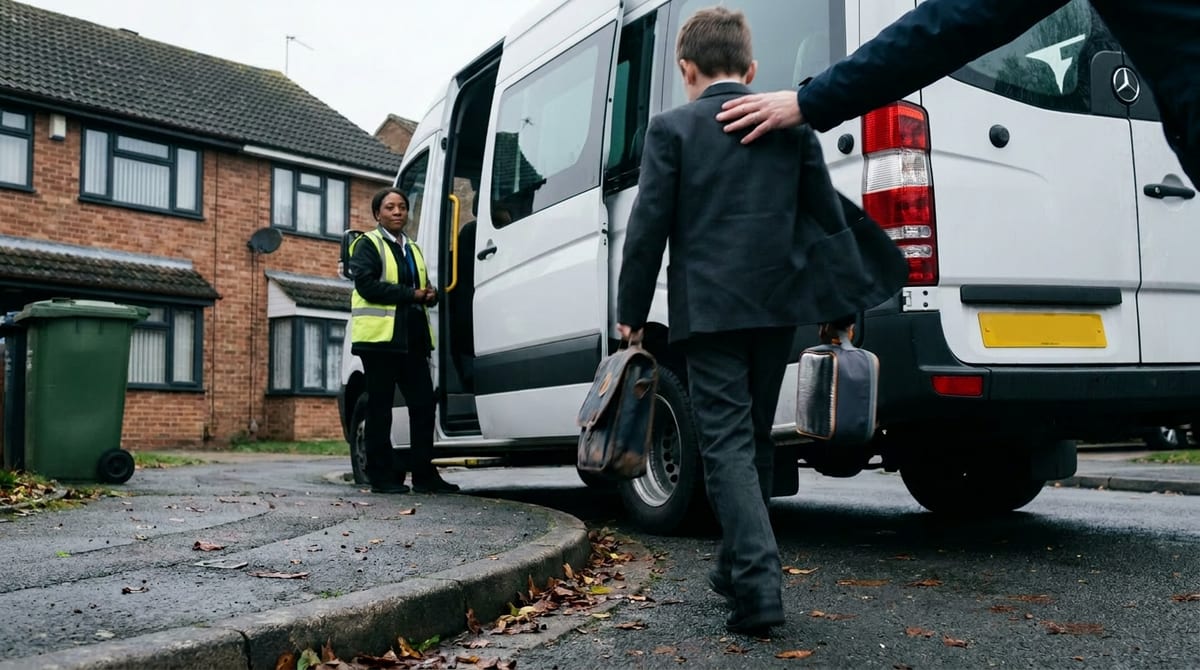
The LA doesn’t have to provide a taxi or minibus. Transport arrangements can include:
- A seat on a school bus or minibus
- A taxi (sometimes with an escort)
- A personal transport budget (PTB) - money paid to you so you can arrange transport yourself
- A mileage allowance for driving your child
- Travel training to help your child learn to travel independently
A personal transport budget can give you more flexibility, if your LA agrees to it. Some families prefer to drive their child and receive the mileage payment, rather than rely on LA-arranged transport that may arrive late or be unsuitable.
How to apply
Transport applications usually go through your LA’s school admissions or transport team. If your child has an EHCP, the transport need should be considered as part of the EHCP process.
You’ll need to provide:
- Proof of your child’s school placement (EHCP naming the school, or offer letter)
- Evidence of why your child can’t walk to school if it’s within walking distance (medical letters, professional reports)
- Your address for distance calculations
If transport is refused
If the LA refuses transport or offers something unsuitable, you can:
- Request a review using the LA’s internal transport appeals process (most LAs have a two-stage appeal)
- Appeal to an independent panel if the first-stage review fails
- Complain to the Local Government and Social Care Ombudsman if the LA hasn’t followed its own policy or statutory guidance
- Appeal to the SEND Tribunal on the school named in Section I of the EHCP - if the tribunal changes the named school, transport duties may change as a result. Note: the tribunal can’t rule on transport itself, only on the school placement
Getting help
IPSEA advises on school transport duties and has guidance on challenging refusals, including when transport should be part of EHCP provision.
Your local SENDIASS can help with transport applications and attend appeal hearings.
Contact has practical guides on school transport for disabled children.
Your child’s education depends on getting there
Transport is what makes the rest of the plan work. If your child can’t get to school, they can’t access the education they’re entitled to.
If the LA isn’t providing transport your child needs, challenge it. The law is on your side.