

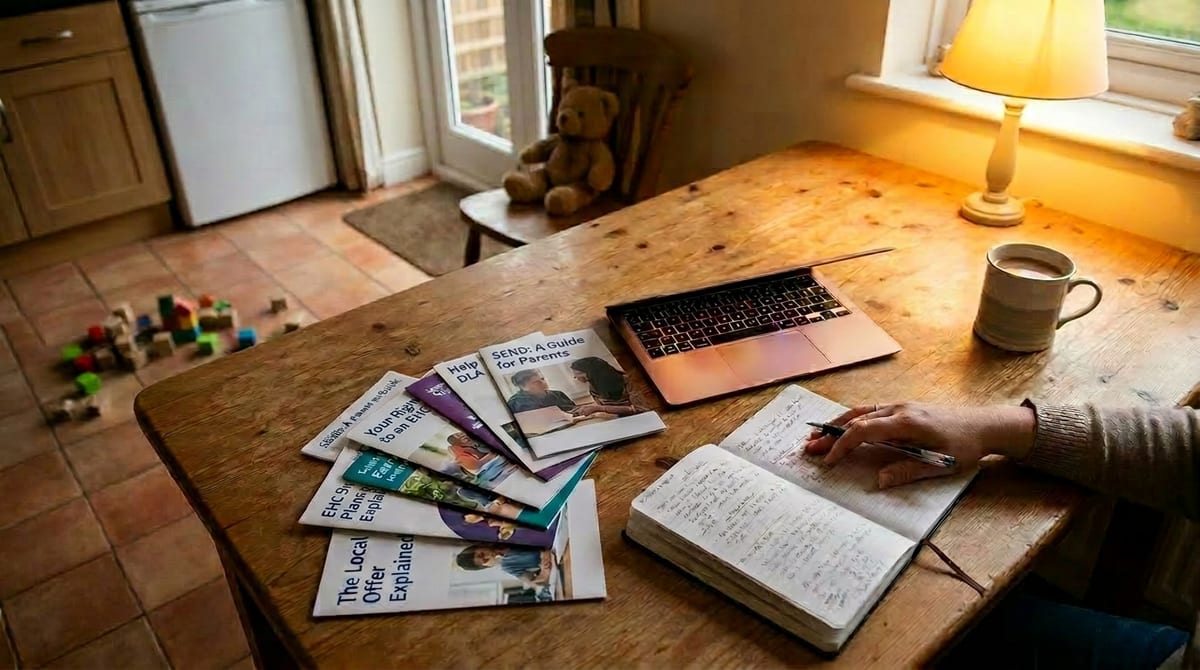
The SEND framework in England covers education, health, social care, benefits, and legal rights, and it takes years to learn properly. Start with three things this week: talk to the school about SEN Support, check your child’s eligibility for DLA, and find your local SENDIASS. Everything else can wait.
Take a breath
You didn’t miss a deadline by not knowing this stuff earlier. The school can still act. The DLA form will still be there on Thursday. Your child’s situation won’t get worse because you took a day to absorb a diagnosis rather than filling in a form the same afternoon.
Three things to do first
Everything else on the SEND to-do list is real, but none of it is more urgent than these, and you don’t have to do them all today.
1. Talk to your child’s school
If your child is school-age, ask to speak to the SENCO (Special Educational Needs Coordinator). Every mainstream school must have one. If you don’t know who it is, the front office will tell you.
Tell the SENCO what you’ve noticed, or what a professional has said. Ask whether your child is on the Special Educational Needs (SEN) register yet. If they’re not, ask for that to be started. It’s the first step to formal support and it doesn’t require a diagnosis.
This is the bit schools sometimes fudge: they hint that they need to see a report, or wait for a specialist assessment, before they can do anything. That’s not what the law says. The school’s duty kicks in when your child has needs that are “additional to or different from” what other children get, and that duty exists whether or not anyone has put a name to those needs yet.
The school doesn’t need a diagnosis to put SEN Support in place. If your child needs help that’s “additional to or different from” what other children get, the school has a legal duty to do its best to meet it under the Children and Families Act 2014.
2. Check if your child is eligible for DLA
Disability Living Allowance (DLA) is a benefit for children who need significantly more help or supervision than a child of the same age without a disability.
DLA is not means-tested. Your income doesn’t matter. It’s based entirely on your child’s needs compared to a typically developing child of the same age.
If your child needs extra help with personal care (washing, dressing, eating, medication, supervision for safety) or has difficulty walking outdoors, it’s worth checking.
When you’re thinking through DLA, ask yourself how much more you do compared with a parent of a child without any disability the same age. Think about personal care, supervision at night, behaviour support, and getting around outside. You don’t need a diagnosis to apply. The care component has no minimum age (babies can qualify); the mobility component starts at age 3 for the higher rate and age 5 for the lower rate.
DLA can also open the door to Carer’s Allowance, the Blue Badge, and extra help through Universal Credit (UC).
3. Find your local SENDIASS
SENDIASS (Special Educational Needs and Disabilities Information, Advice and Support Service) is a free, impartial service that every local authority in England must provide.
They can:
- Explain your rights and your child’s rights
- Help you communicate with the school
- Attend meetings with you
- Help you apply for an EHCP assessment
- Support you through the tribunal process if needed
Every LA has one. Find yours through the Council for Disabled Children directory. For the full picture of what SENDIASS can and can’t do, see our guide: What Is SENDIASS?
SENDIASS is legally required to be impartial. They’re funded by the local authority, but they’re required to operate at arm’s length and give you impartial advice.
Save your SENDIASS phone number in your contacts. They’re a vital free service for most families, though quality can vary between areas.
What comes next (but not today)
Once you’ve done the three things above, these are worth looking into when you’re ready:
-
EHCP assessment - if your child’s needs are significant, you can request an Education, Health and Care needs assessment at any time. The plan that can follow is a legal document that sets out what your child needs and who must provide it.
-
Health referrals - if your child hasn’t been assessed by a paediatrician, speech therapist, occupational therapist, or other specialist, ask your GP for a referral. Waiting lists are long, so starting early helps.
-
Short breaks and social care - if you’re providing significant care for your child, you may be entitled to support from your local authority’s children’s services team, including short breaks.
-
Benefits beyond DLA - once DLA is in place, check Carer’s Allowance and any Universal Credit additions you might qualify for.
Things that can wait
These are important, but they can wait weeks or months:
- Understanding the full EHCP process (learn it when you need it, not before)
- Researching schools or specialist placements (only relevant if your current school can’t meet needs)
- Getting a formal diagnosis (your child can access support without one)
Common myths
You’re going to hear a lot from other parents, well-meaning professionals, and the internet, and some of it is wrong.
“You need a diagnosis before the school will help.” No. Schools support based on need, not on a label. If the SENCO tells you otherwise, they’re describing their preference, not the law.
“DLA is only for children in wheelchairs.” It covers care, supervision, and mobility needs of all kinds. A child with autism, ADHD, anxiety, or complex health needs can qualify.
“The school has to spend £6,000 on your child before they can request an EHCP.” There’s no legal spending threshold for an EHC needs assessment. That figure is sometimes quoted in meetings as if it’s a rule. It isn’t.
Two things that are actually true:
- You know your child best. What you observe at home is valid evidence, and you’re entitled to put it in writing.
- You can request an EHCP assessment yourself. You don’t have to wait for the school to do it.
Getting help
Your local SENDIASS is the first place to go. They’ll help you understand what your child is entitled to and support you through the process.
Contact supports families of disabled children with practical information and a helpline (0808 808 3555).
IPSEA provides free legal advice on education rights for children with SEND.
You’re already doing the right thing
Start with the three things: school, DLA, SENDIASS. And if you hit a wall or don’t know how to phrase something, the free AI assistant covers over 100 SEND topics and can help you work through whatever comes up next.