

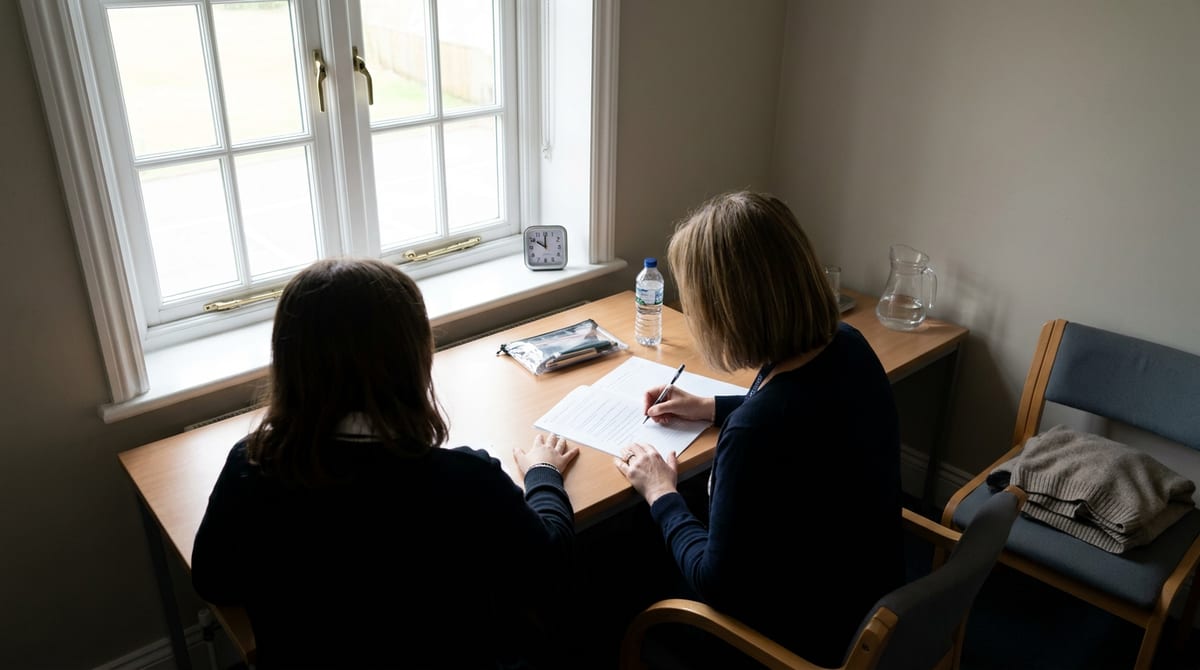
If a disability or special educational need affects how your child performs under standard exam conditions, they may be entitled to adjustments such as extra time, rest breaks, a reader, a scribe, or a separate room. They remove a barrier, not an unfair advantage. The school’s SENCo applies for them, not you, and the evidence needs to be in place well before the exam series.
What are access arrangements?
Access arrangements are adjustments made to exams so that disabled candidates and those with special educational needs can demonstrate their knowledge and skills without being disadvantaged by the assessment method.
They’re governed by the Joint Council for Qualifications (JCQ), which sets the rules for all major exam boards in England. Schools must follow JCQ regulations when applying for and implementing access arrangements.
Types of access arrangements
- Extra time - usually 25%, sometimes 50% for severe needs
- Rest breaks - supervised breaks during the exam (the clock stops)
- A reader - someone who reads the questions aloud
- A scribe - someone who writes the answers as the candidate dictates
- Word processor - a laptop for typing answers
- Modified papers - enlarged print, different colours, Braille
- Separate room - sitting the exam away from the main hall
- A prompter - someone who refocuses the candidate’s attention
- Practical assistant - help with practical tasks in science or art exams
- Sign language interpreter - for deaf candidates
The most common arrangements are extra time (usually 25% extra time, as IPSEA explains), rest breaks, and use of a word processor. But the full range is available depending on your child’s needs.
Who decides?
The school’s Special Educational Needs Coordinator (SENCo) is responsible for assessing whether a student needs access arrangements and applying to the exam board through JCQ Access Arrangements Online (AAO).
Parents cannot apply directly. The application must come from the school. But you can, and should, make sure the school knows about your child’s needs and is taking action.
The SENCo must be satisfied that the arrangement is the candidate’s “normal way of working.” This means the student should already be using the adjustment in class and internal assessments before it’s applied in external exams.
If your child needs extra time in exams, they should already be getting extra time in class tests and mock exams. The JCQ requires evidence that the arrangement is the student’s normal way of working, not something introduced just for the exam.
When to apply
Access arrangements should be applied for well before the exam series. The timeline depends on the type of arrangement:
- Year 9 or earlierIdentify needs and start using adjustments in class. Build the evidence that this is the student’s normal way of working.
- Year 10Formal testing by the SENCo or a specialist assessor. This produces the evidence required by JCQ.
- Autumn of exam yearSENCo applies through JCQ Access Arrangements Online. For the June 2026 exams, JCQ’s final deadlines were 31 January for modified papers and 21 March for everything else.
- Exams beginArrangements are in place and the student knows what to expect.
Don’t leave it until Year 11. If your child is in Year 9 or 10 and you think they might need access arrangements, talk to the SENCo now. The evidence needs time to build.
Evidence needed
JCQ requires specific evidence to support an application. The SENCo must demonstrate three things:
- History of need - evidence that the student has a learning difficulty or disability that substantially affects them
- Normal way of working - proof that the adjustment is already being used in school
- Assessment evidence - a formal assessment by the SENCo or a specialist assessor
The most persuasive evidence comes from EHCP or SEN Support documentation, reports from educational psychologists or specialist teachers, and standardised test results from the school (such as processing speed, reading speed, or writing speed scores). Teacher reports and internal exam records showing the student already using the adjustment in class are also crucial.
A diagnosis alone isn’t enough. JCQ needs evidence that the need actually affects exam performance. Similarly, a parent’s request alone won’t work. The school must support the application with their own evidence.
For extra time, the assessment typically involves standardised tests measuring processing speed, reading speed, or writing speed. For a reader, evidence of reading difficulty is needed. For a scribe, evidence of writing difficulty. Note that under the JCQ access arrangements rules, specialist assessments must have been carried out within 26 months of the exam. If your child was assessed last year for something else, such as an EHC needs assessment, check the date on that report before assuming it still counts.
Private assessments
If the school hasn’t assessed your child and you believe they need access arrangements, you can arrange a private assessment by a specialist assessor or educational psychologist. The assessor has to contact the school and be approved by the head of centre before assessing your child, or the school can’t use the report.
The JCQ accepts three kinds of assessor: one with a Level 7 access arrangements qualification, a specialist teacher with a current SpLD Assessment Practising Certificate, or a psychologist registered with the Health and Care Professions Council.
A private assessment typically costs £500 to £900 for a specialist assessor, and more for an educational psychologist. If the school approved the assessor first and the assessment confirms a need, the SENCo can use the findings to support a JCQ application. But the school must still agree to implement the arrangement.
What if the school won’t apply?
If you believe your child needs access arrangements and the school disagrees:
- Ask the SENCo for a meeting to discuss your concerns
- Provide any professional reports you have (from your child’s therapist, psychologist, or paediatrician)
- Put your request in writing to the SENCo and the headteacher
- Contact your SENDIASS (Special Educational Needs and Disabilities Information, Advice and Support Service) for advice and support
- If your child has an EHCP, ensure the access arrangements are discussed at the annual review
If the school still won’t act and your child has a disability, a refusal to make reasonable adjustments in exams could amount to disability discrimination under the Equality Act 2010.
Access arrangements for SATs
Primary school children can also receive access arrangements for Key Stage 2 SATs. The process is different, as SATs are administered by the Standards and Testing Agency (STA) rather than JCQ. The school applies directly.
Available adjustments for SATs include extra time, rest breaks, a reader, a scribe, and modified papers. For extra time, the school applies to the STA, which decides based on the child’s normal way of working, though a child with an EHCP automatically qualifies for up to 25% with no application needed. Rest breaks and a reader can be arranged directly by the school, without applying to the STA, as long as they reflect the child’s normal classroom practice.
Getting help
Your local SENDIASS can advise on access arrangements and help you communicate with the school if there’s a disagreement.
IPSEA (Independent Provider of Special Education Advice) provides free legal advice on education rights, including exam adjustments for children with SEND.
JCQ Access Arrangements guidance is the official rulebook. It’s technical, but reading the relevant sections can help you understand what your child is entitled to.
Your child deserves a fair exam
Talk to the SENCo early. Build the evidence. And don’t accept “we don’t do that” as an answer. The rules are clear, and your child has the right to a fair assessment.