

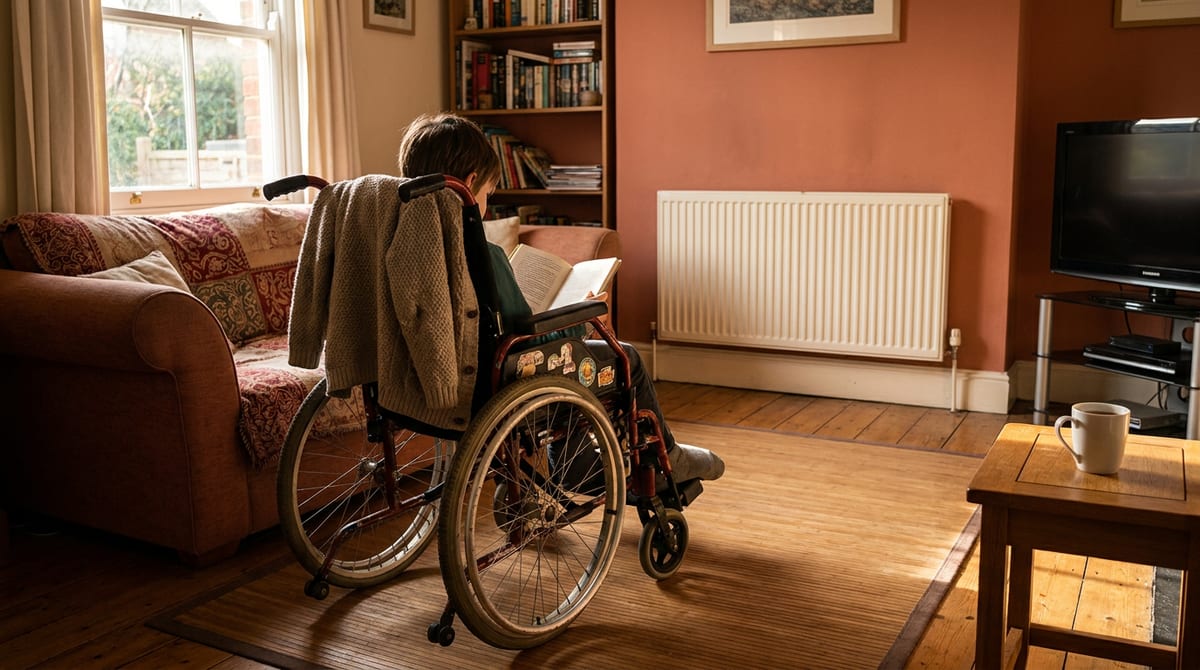
A wet room so your child can bathe safely. A wheelchair that fits properly. A ceiling hoist so you don’t injure your back lifting them. Widened doorways so the wheelchair actually gets through.
This equipment isn’t optional. It’s what makes daily life possible. And there are multiple funded routes to get it, though nobody tells you about all of them at once.
Four funded routes
Most families discover one route and assume that’s all there is. In fact, four funded routes exist, and they cover different things:
These aren’t alternatives. Your child might be eligible for all four, covering different needs at the same time.
Route 1: Disabled Facilities Grant (up to £30,000)
The DFG is a mandatory council grant for essential home adaptations. For children under 18, there’s no means test. The council can’t refuse an eligible application on grounds of budget. The maximum grant is £30,000 under the Housing Grants, Construction and Regeneration Act 1996, and the grant is mandatory: the council must approve eligible applications.
The DFG covers:
- Ramps and level access to the home
- Wet rooms and accessible bathrooms (level-access shower, adapted toilet)
- Stairlifts and through-floor lifts
- Widened doorways for wheelchair access
- Ceiling hoists and tracking systems
- Adapted kitchens (lowered worktops, accessible storage)
- Extensions or bedroom conversions where existing space can’t be adapted
The process starts with an occupational therapy (OT) assessment. The OT assesses your child’s needs and recommends specific adaptations. The council then assesses the application against the mandatory criteria.
Don’t start any adaptation work before the grant is approved. Under Section 29 of the Housing Grants Act, works must not begin before grant approval. If you start early, you lose DFG eligibility for that work.
- OT referralRequest an OT assessment through your GP, health visitor, or social services.
- OT assessmentThe OT visits your home, assesses your child’s needs, and recommends adaptations.
- DFG applicationSubmit an application through your local council’s housing department.
- Council decisionThe council must decide within 6 months of application.
- Works completedCouncil arranges contractors or you manage the work. Grant paid in stages.
If the cost exceeds £30,000, the council can provide discretionary top-up funding under the Regulatory Reform (Housing Assistance) Order 2002. Not all councils offer this, but it’s worth asking.
Route 2: NHS wheelchair services
Children’s wheelchairs are provided free through NHS services commissioned by Integrated Care Boards (ICBs). The NHS target is delivery within 18 weeks of referral, though actual waiting times vary by region.
Ask your GP, physiotherapist, or paediatrician to refer your child. Some services accept self-referral. The service carries out a clinical assessment covering mobility needs, postural requirements, and (for powered chairs) cognitive readiness.
Since December 2019, every child who qualifies for a wheelchair has a legal right to a Personal Wheelchair Budget (PWB). This gives you three options:
- Notional - choose within NHS-commissioned services
- Third-party - use the budget outside NHS services
- Direct payment - hold the money and arrange independently
You can top up the PWB with your own funds to access a higher-specification wheelchair.
If the wheelchair is needed for your child to access education, request that it’s specified in Section F of the Education, Health and Care Plan (EHCP). This creates a Local Authority (LA) duty to provide it (the duty only lifts if you’ve already made suitable alternative arrangements yourself), giving you an additional enforcement route beyond the NHS.
Route 3: Council OT assessment
An OT assessment through social services or the NHS can open the door to equipment for daily living that sits outside the DFG and wheelchair routes.
This includes:
- Specialist beds and mattresses
- Bath aids and shower seats
- Standing frames and walking aids
- Toilet equipment (raised seats, support rails)
- Hoists and slings (portable, not installed)
- Specialist seating for feeding and posture
Under the Chronically Sick and Disabled Persons Act 1970, once a council assessment identifies equipment as “necessary” for a disabled child, the council must provide it in full. Financial reasons can’t override this duty.
If you’re told there’s a waiting list for an OT assessment, put your request in writing and keep a copy. Waiting lists don’t remove the duty. If the wait feels unreasonable given your child’s circumstances, escalate via the council’s complaints procedure.
Route 4: Charitable grants
When statutory services won’t cover a specific item, charitable grants can fill the gap:
| Status | Criterion |
|---|---|
| Note | - Family Fund - equipment, computers, sensory items, household goods for low-income families with disabled or seriously ill children aged 0-17 (a separate Your Opportunity scheme covers 18-24) familyfund.org.uk |
| Note | - Newlife Foundation - specialist equipment including beds, wheelchairs, communication aids, and postural equipment newlifecharity.co.uk |
| Note | - Whizz-Kidz - powered wheelchairs and mobility equipment for children whizz-kidz.org.uk |
| Note | - Cerebra - grants for children with brain conditions cerebra.org.uk |
| Note | - Turn2us - online grant-finder searching multiple charities turn2us.org.uk |
These grants are typically £100-2,000 and can be applied for alongside statutory routes.
The OT assessment: the gateway to everything
An OT assessment is the starting point for most funded equipment. It opens the door to the DFG, council-provided equipment, and provides evidence for charitable grant applications.
If your child doesn’t have an OT assessment, request one through:
- Your GP (referral to community OT)
- Children’s social services (as part of a Section 17 assessment)
- Your child’s school or SENCO
- Self-referral (available in some areas)
The OT will assess your child at home, looking at how they move around, what barriers exist, and what equipment would help. Their report becomes the evidence base for everything else.
Getting help
Contact (0808 808 3555) advises on all routes to equipment, including DFG, wheelchairs, and charitable grants.
Scope (0808 800 3333) provides guidance on accessing equipment and challenging refusals.
Citizens Advice can help with DFG applications and council complaints.
Newlife Foundation offers an equipment helpline and emergency equipment loans.
Start with the OT assessment
Whatever equipment your child needs, the OT assessment is the key that opens most doors. Request one now if you don’t have one. It provides the evidence for DFG applications, council equipment provision, and charitable grants.
Don’t accept being told there’s nothing available. Four separate funded pathways exist. Your child has the right to the equipment they need to live safely and participate in daily life.