

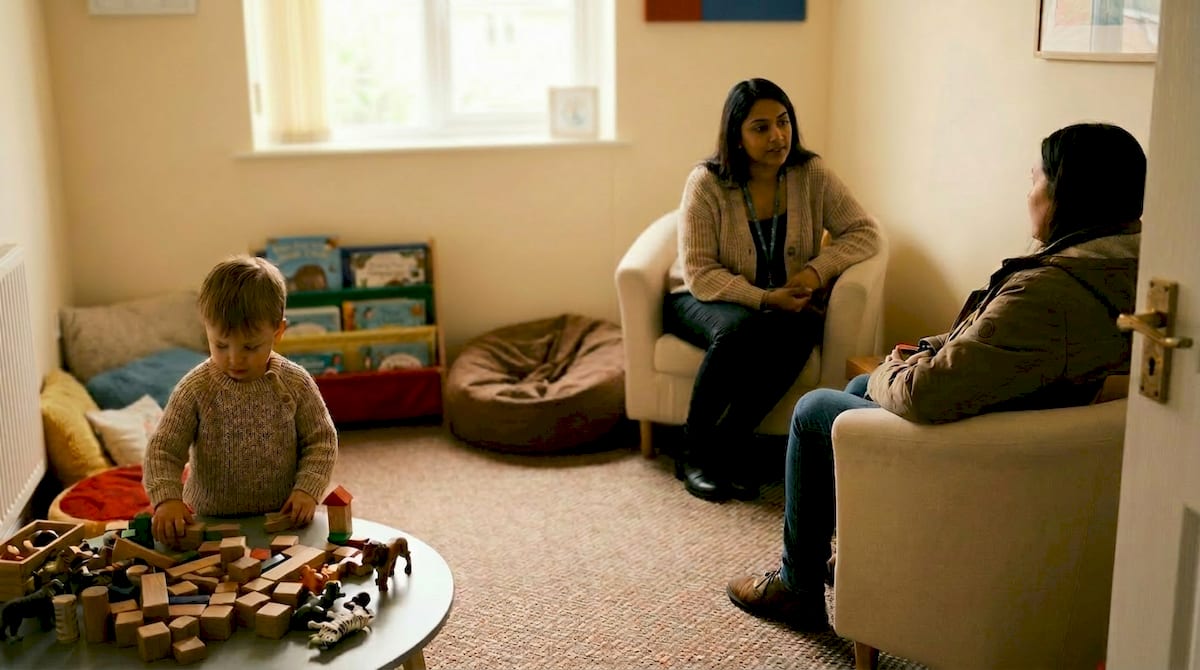
A GP or school refers your child to a specialist team for assessment, and in many areas that wait now runs into years rather than months. Nothing about the wait stops you getting help now.
The NHS diagnostic pathway
The exact pathway varies by area, but it typically involves:
- GP or school referral to the local neurodevelopmental or Child Development Centre (CDC) team
- Initial screening - sometimes a questionnaire or brief assessment
- Multi-disciplinary assessment - a team of professionals (paediatrician, speech therapist, psychologist) observes and assesses your child
- Diagnostic decision - the team reaches a conclusion and shares it with you
- Post-diagnostic support - recommendations for support, sometimes including therapy referrals
The wait
Some areas have waits of 2-3 years for an autism assessment. ADHD pathways can be similarly long, and both have grown significantly since the pandemic.
Your child doesn’t need a diagnosis to access SEN Support at school, to apply for Disability Living Allowance (DLA), or to request an Education, Health and Care Plan (EHCP) assessment. All three are needs-based, not diagnosis-based. Don’t let the wait stop you from getting help now.
The diagnostic process and the support process are separate, so you can pursue both at the same time.
Right to Choose
If your child is referred for an ADHD assessment, you have a legal right under the NHS Constitution to choose which provider carries out the assessment. This is called Right to Choose.
In practice, this means you can ask your GP to refer your child to a private provider that has an NHS contract, rather than waiting for the local NHS service. Some of these providers have much shorter waiting times.
How it works:
- Ask your GP for a referral for ADHD assessment
- Request that the referral goes to a Right to Choose provider (such as Psychiatry-UK or Clinical Partners)
- The NHS pays for the assessment - you don’t pay anything
- The wait is often significantly shorter than the local NHS pathway
Right to Choose currently applies most clearly to ADHD assessments. For autism, the pathway is more complex and the availability of Right to Choose providers varies by area. Ask your GP what’s available locally.
Our full guide to Right to Choose for ADHD and autism assessments walks through the exact script to use with your GP, which providers to name, and the shared-care catch that trips some families up.
Not all GPs are aware of Right to Choose, and some initially refuse. If your GP says they can’t do it, you can point them to NHS England’s guidance. Be aware that Right to Choose for ADHD has faced restrictions in some areas, and NHS England guidance has evolved since 2023-24, so what applies locally can differ. Your local SENDIASS or Patient Advice and Liaison Service (PALS) can help if you hit resistance. PALS is a confidential service that helps resolve complaints and concerns about NHS services.
Private diagnosis
Some families pay for a private assessment to avoid the wait.
Advantages:
- Much shorter waiting times (often weeks rather than years)
- You choose the professional
- Detailed report produced quickly
Things to consider:
- Cost varies widely (typically £500-£2,000+)
- Some NHS services and LAs may not accept a private diagnosis without their own confirmation
- Post-diagnostic support still comes through the NHS
- Quality varies between providers
If you go private, make sure the professional is appropriately qualified and registered with the relevant regulatory body (GMC for doctors, HCPC for psychologists).
What a diagnosis does (and doesn’t) do
A diagnosis can:
- Help you and professionals understand your child’s needs
- Provide a shared language for discussing support
- Make it easier to explain your child’s needs to school
- Give access to some diagnosis-specific support (e.g., autism-specific social groups)
- Provide emotional validation for you and your child
A diagnosis doesn’t:
- Automatically trigger any support, funding, or provision
- Guarantee an EHCP, DLA, or any other benefit. They’re all needs-based: the test is whether your child needs support, not whether they have a label. An EHCP is granted based on whether the child’s needs require the provision it describes, not on having a particular diagnosis.
- Change who your child is
- Give the school permission to treat your child differently (they should already be supporting their needs)
- DLA, EHCP, and SEN Support don’t require a diagnosis
- Needs-based
- But it’s context, not a ticket
- Diagnosis helps
Getting support while you wait
Our guide to getting support without a diagnosis covers each of these routes in detail. While you wait for a diagnosis, pursue support based on your child’s needs right now:
- Talk to the school. Ask for SEN Support to be put in place based on what they’re observing in the classroom. No diagnosis is needed.
- Apply for DLA. If your child needs significantly more help than a child of the same age, you can apply regardless of diagnosis. The DLA form asks about needs, not labels.
- Request an EHCP assessment. You can ask for one at any time, whether or not school support feels like it’s working; there’s no minimum length of time on SEN Support you need first. The legal test is about needs, not diagnoses.
- Ask your GP for interim support. Occupational therapy, speech therapy, and other referrals can happen while you wait for the diagnostic assessment.
Getting help
Your local SENDIASS can advise on the diagnostic pathway in your area and help you access support while waiting.
Contact supports families of disabled children with information about diagnosis pathways and what to do while waiting.
National Autistic Society has detailed guidance on the autism diagnostic pathway, including what to expect and how to prepare.
Don’t wait to get help
A diagnosis matters. But it’s not the starting point for support. If your child needs help now, pursue it now. The waiting list for an assessment shouldn’t become a waiting list for everything else.